
How to Hire a Contractor in Antigua Guatemala
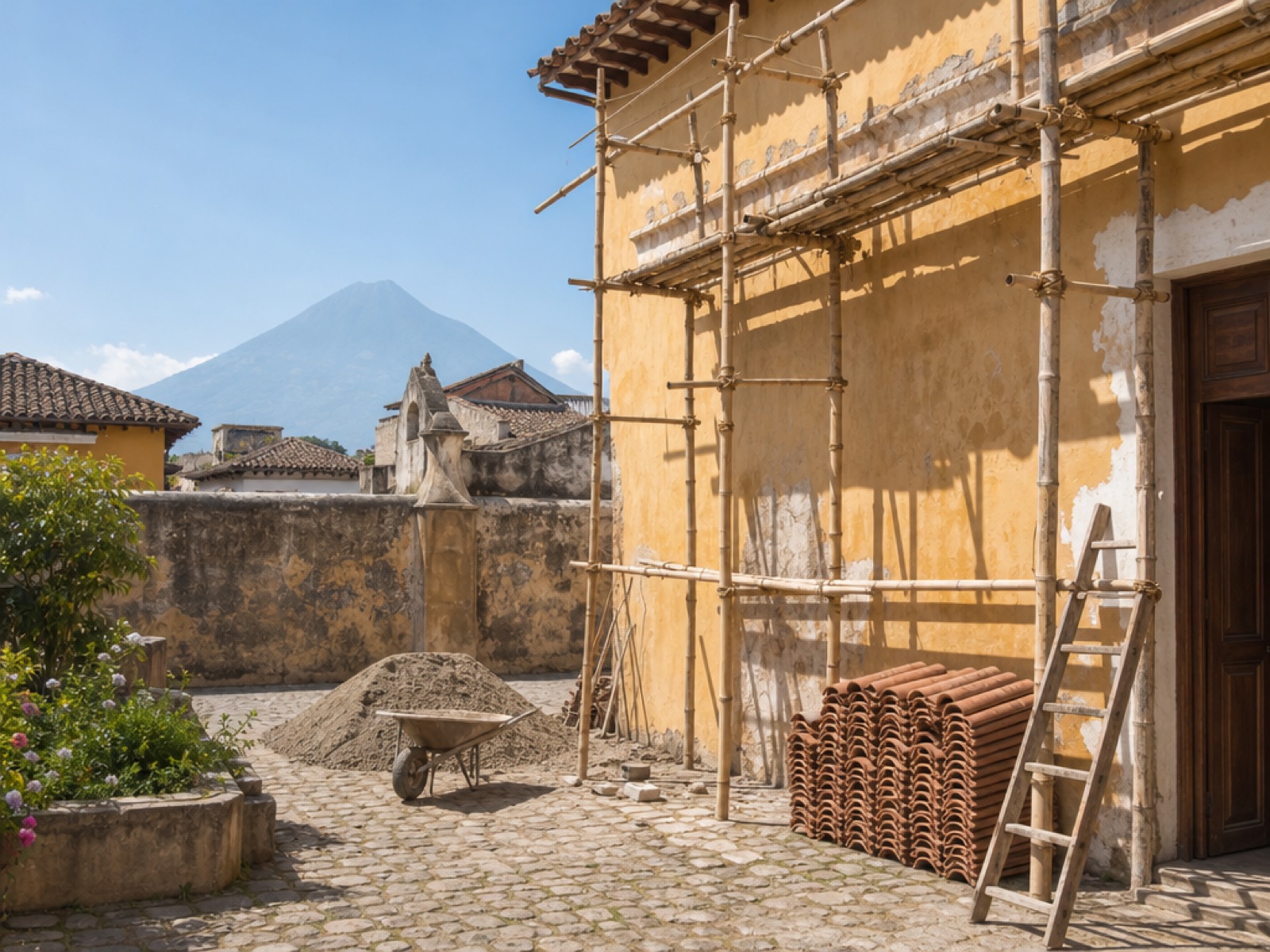
Hiring a contractor in Antigua Guatemala comes down to one choice: a maestro de obra who runs a crew at a daily rate, or a full-service builder who prices the whole job and manages it for you. Labour is cheap here, a maestro de obra earns roughly Q300 to Q500 a day ($40 to $65 USD), so the final bill is driven far less by the wage rate than by how well the project is managed. Almost every overrun we see foreign owners hit in Antigua comes from an unclear scope and loose supervision, not from greedy trades.
Why the contractor matters more than the price
A colonial house is not a modern box. The walls are 40 to 80 cm of adobe, bahareque or block under lime render, the roof is clay tile on timber beams, and much of the work has to respect fabric that is centuries old. Get the wrong crew and you pay twice: once for the job and again to undo it. If you are buying a property specifically to restore it, our colonial restoration guide covers the structural checks and the heritage rules. For the raw numbers, the renovation costs guide breaks down what each trade charges. This post is about the person you put in charge of the money.
Who can you actually hire in Antigua Guatemala?
There are four people foreign owners end up hiring, and they are not the same:
- The maestro de obra. A working foreman who runs a crew of masons, helpers and often a carpenter. He is the traditional general contractor here. He usually quotes by the day or by the square metre and expects you to make the decisions.
- The architect or engineer (arquitecto or ingeniero colegiado). Designs the work, files the municipal and CNPAG paperwork, and can supervise the build. Essential when the project touches the street facade or the structure.
- The full-service builder (constructora). Prices the entire job, supplies labour and materials, and carries the risk of the estimate. More expensive per unit, far less time from you.
- The independent project manager. Hired by absentee owners to control a maestros crew on their behalf, usually for a percentage of the build.
What does a contractor cost in Antigua Guatemala in 2026?
These are typical 2026 rates for Antigua and the surrounding villages. Materials sit on top and usually run close to the labour on a full renovation.
| Role | 2026 rate |
|---|---|
| Maestro de obra (foreman) | Q300 to Q500 per day |
| Albañil (mason) | Q150 to Q300 per day |
| Ayudante (helper) | Q100 to Q180 per day |
| Carpenter | Q250 to Q450 per day |
| Electrician | Q250 to Q500 per day |
| Plumber | Q250 to Q450 per day |
| Painter | Q200 to Q350 per day |
| Architect, design and supervision | 5 to 8 percent of build cost |
| Absentee project manager | 8 to 12 percent of build cost |
A fixed-price builder quote will look higher than a day rate, and usually should. You are paying for someone else to carry the risk of a colonial discovery, a beam that is rotted through or a floor that has moved.
How do you check a contractor before you hire?
Ask for three recently completed jobs and go and see them, not just the photos. Ask the owners directly whether the crew finished on time and came back for snags. In a town the size of Antigua, word of mouth travels fast and a builder with a bad record cannot hide it for long.
Confirm what the quote actually covers. Ask whether the price includes materials, scaffolding, waste removal and the permit trámite, or only labour. A quote that leaves materials open is not a quote, it is a starting point. For any work on the street facade, confirm the builder has done CNPAG submissions before, because the rules for a UNESCO-listed town are not the same as for a new build on the edge of town.
What should the contract and payment schedule look like?
Put the scope in writing, ideally in Spanish and English, with a drawing or a room-by-room list. Then pay in milestones, never in one go. A normal structure is a deposit of 20 to 30 percent up front for materials, then stage payments as walls, roof, plumbing and finishes are completed and inspected. Keep a final 5 to 10 percent until the snag list is closed.
Never pay the full job in advance, however well you know the builder, and ask for receipts on materials. If the crew is buying cement on your account, you want to see the invoices.
What are the red flags?
- A large cash payment up front with no written scope.
- A quote given in one line, with no breakdown by trade or stage.
- Evasiveness about permits, or a promise that you “don’t need” CNPAG approval for facade work.
- The lowest bid by a wide margin, which almost always means cutting corners on materials.
- No fixed address, no references you can actually visit, no completed project you can see.
How do you manage a build from abroad?
Many owners in Antigua live elsewhere while the work happens. That is workable, but only with eyes on site. Hire an independent project manager, or a property manager you trust, and set a rhythm: a weekly photo or video update by WhatsApp, phased payments tied to those updates, and one English-speaking point of contact. Our guide to managing a property as an absentee owner covers how that arrangement is normally set up.
The short version: the labour in Antigua is affordable and the craftsmanship is real, but the project only stays on budget when someone with skin in the game is watching it closely. That someone can be you, an architect, or a manager you have vetted.
If you are buying a property and need trades you can trust, or you want an honest read on what a renovation will really cost before you make an offer, talk to Luna Jerney and the team at Antigua Real Estate Development. We work with local masons, carpenters and architects who have delivered colonial projects across Antigua, and we can connect you with the right people for the job. Browse properties for sale or review our services to see how we support buyers from first viewing to move-in day.
Interested in Antigua Real Estate?
Whether you're looking to buy, rent, or invest. I can help. Free consultation, no pressure.