
Parking and Garages in Antigua Guatemala Homes
Parking and Garages in Antigua Guatemala Homes
Antigua’s street grid was laid out centuries before anyone here owned a car, and it shows. Most houses inside the 12-by-12-block historic center have no garage, street parking needs a municipal permit, and private lots charge by the hour. If you plan to keep a car, parking should decide which neighborhood you buy in.
Can you park on the street in Antigua Guatemala?
Yes, but only where the municipality allows it and only with the right permit. Street parking is controlled by a marbete, a daily permit bought from the municipal transit agents who work the streets. For vehicles with Guatemalan plates it costs around Q10 per weekday. Foreign plates are generally exempt, though enforcement varies.
The kerb tells you where parking is legal, and the colour system is enforced:
- Grey: parking allowed.
- Red: no parking at any time.
- Yellow: loading and unloading only.
- White: motorcycles only.
Parking outside those markings brings a fine from the Municipalidad de Antigua, which issues them actively. Inside the historic center, on-street space is nearly impossible on a weekday and effectively impossible on weekends, during Lent and Semana Santa, and on any festival date. The streets are narrow, cobbled and often blocked by delivery trucks, which is why most Centro residents either rent a lot space or do not own a car.
What does parking cost in Antigua Guatemala?
There are no meters or parking apps in most of the city: you pay attendants, private lots or the municipality. Rates checked in October 2026:
| Option | Typical cost (2026) | Best for |
|---|---|---|
| Street parking with marbete, local plates | ~Q10 per weekday | Short stops outside the center |
| Hourly private parqueo | Q10 to Q15 per hour | Errands and appointments |
| Day rate near Parque Central | Q40 to Q80 per day | Full-day visits |
| Overnight in a staffed lot | Q100 to Q200 ($13 to $25) | Guests with a rental car |
| Monthly space in a gated lot | $50 to $100 per month | Residents with a car, no garage |
| Municipal event lot, RN-10 | ~Q5 in regular hours | Semana Santa, 500+ vehicles |
Monthly spaces are the number that matters for residents, and availability is the constraint: staffed lots near the center fill up and run waiting lists. If you buy a house in the casco with no off-street parking, ask about a monthly space before you sign the escritura.
Which areas of Antigua have garages and driveways?
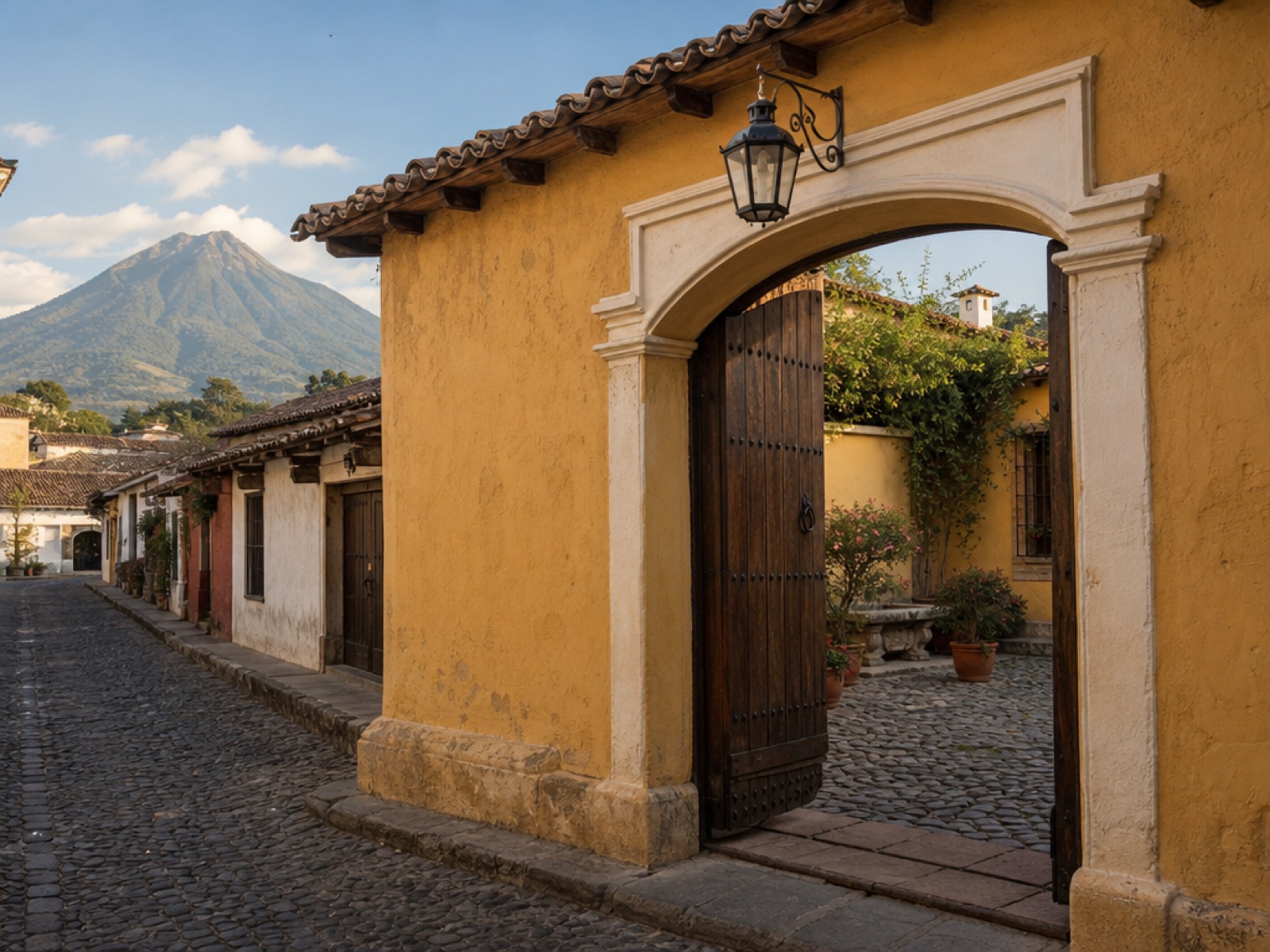
- Centro histórico: houses built with courtyards and a zaguán, the wide entrance corridor, not with garages. A few owners have converted part of a patio into one or two off-street spots behind the original wooden door, and those properties ask a premium.
- Barrios just outside the center (Santa Inés, San Felipe): mid-century and newer houses, more likely to have a driveway or a covered bay.
- Ring villages (San Pedro Las Huertas, Jocotenango, Ciudad Vieja): modern construction, private garages, gated entrances, and a car is expected. You trade walkability for parking.
- Hillside and rural plots (El Hato and above): room to park, unpaved or steep access, and you want a vehicle with clearance.
If you want both a colonial house and a garage, the realistic version is a restored house in a barrio or a village, not one on the Parque Central. See what is on the market at /properties/.
Can you add a garage to a colonial home in Antigua?
Sometimes, and the permit is the hard part. Antigua’s protected perimeter is governed by Decreto 60-69: every new construction or alteration needs a prior licence from the CNPAG, the council that protects the city, and new buildings of two or more floors are not allowed in the conservation area. Cutting a garage opening into a street-facing colonial wall changes the facade, so approval is not automatic.
The routes that do get built:
- A covered bay inside the patio behind the existing zaguán, keeping the original wooden doors. The street facade stays untouched, which is what the CNPAG cares about.
- A space off a side street or a shared entrance, where the property has one.
- Widening the existing entrance so a car clears the arch and the turn from the street.
Two practical warnings. A patio is usually the only daylight for the rooms around it, so roofing it for a car costs you light in the main living areas. And check the ramp drain: a garage floor set below street level without drainage becomes a cistern in September. Ask the seller for the CNPAG licences on any conversion already built, as you would for a roof or a bathroom.
Does parking affect resale and rental value?
Yes, measurably. Inside the casco, off-street parking is rare enough to appear in the first line of a listing, and buyers with cars filter on it. Short-term rental guests on a driving holiday ask about parking before they book, and “there is a staffed lot two blocks away” still closes bookings.
If you buy as an absentee owner, put the monthly lot space into your numbers as an operating cost, the way you budget utilities, pool service and management. It is a small line next to a mortgage, but a real one.
What if you would rather not own a car?
The historic center is the easiest place in Guatemala to live without one. The core is flat, roughly 12 blocks by 12, and walkable end to end in about 20 minutes. Tuk-tuks cover short trips for Q5 to Q15, taxis are everywhere, and shuttles to Guatemala City and the airport run daily. Many Centro residents made that trade, and their transport budget runs well under what the parqueo alone would cost.
What should you check before buying?
Run through this on the viewing, not from the listing photos:
- Measure the entrance: gate width, arch height and the turning space from the street decide whether your car fits.
- Drive in and out, in the direction you would really use, including reversing into traffic.
- Check whether the water tank, cistern or gas cylinders sit where a car would go.
- Ask whether a monthly space is available in a nearby staffed lot, and what it costs today.
- Request the CNPAG licences for any garage, roof or patio conversion already built.
- Check the kerb in front of the house: grey means you may park there sometimes, red means never.
Work with an agent who knows these streets
Parking does not show up in a listing and does show up in your first week of living here. We walk properties in every sector of Antigua and can tell you which houses have a real off-street spot, which ones only look like they do, and what the CNPAG will approve.
Browse current listings at /properties/, see how we support buyers at /services/, or write to us at /contact/ and we will shortlist houses that match how you get around.
Interested in Antigua Real Estate?
Whether you're looking to buy, rent, or invest. I can help. Free consultation, no pressure.