
Roof Repair and Maintenance in Antigua Guatemala
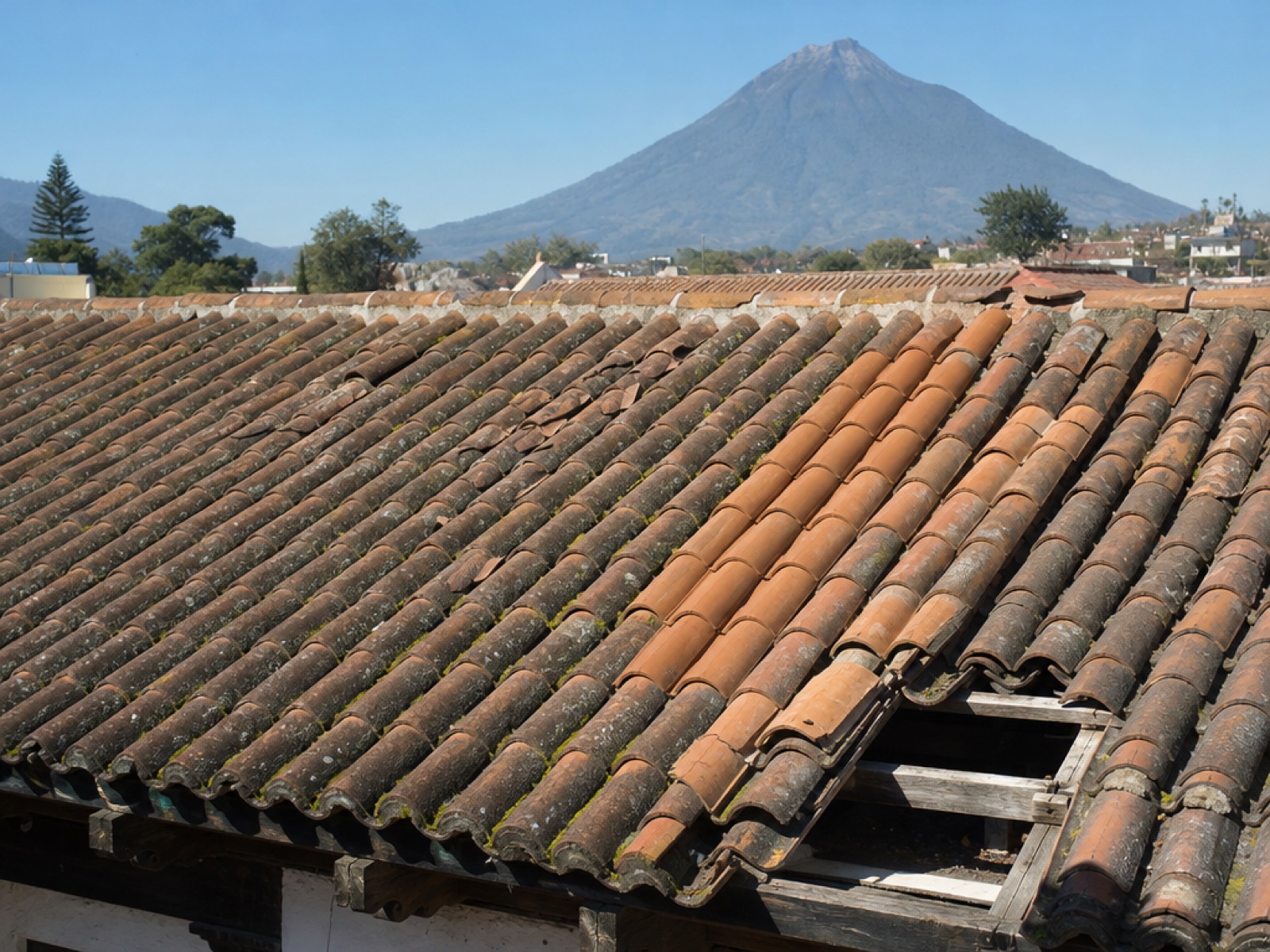
Roof Repair and Maintenance in Antigua Guatemala
In Antigua Guatemala your roof is the single most expensive thing you will maintain, and it is the first thing the rainy season tests. A small tile repair runs about Q1,500 to Q8,000 ($195 to $1,040), while a full re-roof with new underlayment on a colonial house typically lands between Q80,000 and Q250,000 ($10,400 to $32,500). Knowing which one you actually need is where most owners lose money.
Almost every colonial home here wears a roof of curved clay barrel tiles, teja de barro, laid over wooden beams and an underlayment layer. The tiles themselves are remarkably durable and can last 40 to 60 years or more. The part that fails first is almost never the tile. It is the layer underneath, the mortar at the ridges and valleys, and the wood that holds everything up.
How long does a clay tile roof last in Antigua Guatemala?
With basic maintenance, a well-built teja roof lasts 40 to 60 years, and many in the historic center are older than that and still dry. Without maintenance, the same roof can start leaking within a decade.
The clay is only the outer shell. Water that gets past a cracked tile sits on the underlayment, and once that layer is tired it fails across a wide area, not in one spot. By the time you see a stain on the ceiling, the damage has usually been building for a season or two.
What actually goes wrong with colonial roofs here?
Roofs in Antigua fail in a predictable handful of ways:
- Displaced or cracked tiles. Strong wind, animals on the roof, falling branches and simple age shift tiles out of line. One gap is enough to let water in.
- Leaks at ridges, valleys and penetrations. The mortar at the ridge line, the hips, and around chimneys, vents and skylights cracks over time. These are the most common leak points.
- Tired underlayment. The waterproof layer beneath the tiles hardens and splits, often after 20 to 30 years.
- Rot and termites in the beams. Once water reaches the wooden structure, beams soften, sag and attract termites, which turns a roof repair into a structural repair.
- Moss, lichen and plants. The wet season grows greenery in the tile valleys and gutters, which holds moisture against the roof and blocks drainage.
What does roof repair cost in Antigua Guatemala in 2026?
Prices vary with roof size, access and how much structure is involved. These are typical ranges for the Antigua area, verified against local contractors in 2026.
| Job | Typical cost (quetzales) | Typical cost (USD) |
|---|---|---|
| Replace a few broken or slipped tiles | Q1,500 to Q3,000 | $195 to $390 |
| Repoint ridges, hips and valleys | Q2,500 to Q8,000 | $325 to $1,040 |
| Replace a section, 10 to 20 m² | Q6,000 to Q18,000 | $780 to $2,340 |
| Waterproof coating on a flat azotea | Q4,000 to Q12,000 | $520 to $1,560 |
| Full re-roof with new underlayment | Q80,000 to Q250,000 | $10,400 to $32,500 |
| Replace rotted beams and structure | Q15,000 to Q60,000 | $1,950 to $7,800 |
| Annual inspection and cleaning | Q800 to Q2,500 | $105 to $325 |
A safe rule for a modest house: budget 0.5 to 1 percent of the property value per year for maintenance, and the roof takes the largest share.
Can you repair a roof inside the UNESCO heritage zone?
Yes, but with rules. Antigua’s historic center is a UNESCO World Heritage site, and the heritage authority, the CNPAG, along with the municipality, cares about what is visible from the street and about the building’s character.
In practice this means keeping traditional clay tile rather than switching to modern metal or plastic sheeting on a visible slope, avoiding new roof structures that change the roofline, and getting a permit before any major work. Straight replacement of broken tiles with matching teja, and repointing of mortar, is normal maintenance and does not need a full permit. A re-roof, a new skylight or a roof terrace usually does.
Repair or replace: how do you decide?
Repair makes sense when the structure is sound, the leaks are recent and localized, and the underlayment is still doing its job. Replace when you see several of these together:
- More than two or three separate leaks in a single rainy season
- Sagging, spongy or visibly cracked beams
- An underlayment that crumbles when you touch it
- A roof that is 60 years old or more with no record of a re-roof
- Tiles so brittle that new cracks appear every season
An honest contractor will tell you which one you are looking at.
What should you check before and during the rainy season?
The dry months, roughly November to April, are when you do roof work. Do not wait for the first downpour. A short pre-season checklist saves most owners a mid-season emergency:
- Walk or have someone walk the roof and look for slipped, cracked or missing tiles.
- Clear gutters and downspouts of leaves, dirt and plants so water drains away from the walls.
- Check the mortar at ridges, hips, valleys, chimneys and any skylight.
- Trim tree branches that hang over the roof, since they scratch tiles and drop debris.
- Look inside the attic or ceiling for fresh stains, damp patches or a musty smell after the first heavy rain.
- Photograph anything that looks wrong, both for your records and for getting quotes.
If you are buying, this is one of the most useful things to inspect before you close, alongside the water, electrical and structural checks.
How do you avoid being overcharged?
Roof work is easy to inflate because most owners cannot see the roof and do not know the going rate. A few habits keep it fair:
- Get two or three written quotes for the same scope of work, not verbal estimates.
- Ask explicitly whether the price includes new underlayment or only tiles. The answer changes the number a lot.
- Ask for photos before, during and after, especially if you are an absentee owner.
The bottom line
Your roof is the part of an Antigua Guatemala home that quietly decides whether the house stays dry, saleable and worth what you paid. Clay tile lasts a long time when it is looked after, and the money you spend on an annual inspection is a fraction of what one ignored leak costs in beams, ceilings and plaster. Treat the roof as a yearly habit, not a crisis, and it will never be the reason your home loses value.
If you own property here, or you are considering a colonial home and want to know what the roof really needs before you buy, get in touch with Luna. Browse current listings in Antigua Guatemala or see how we handle property management for owners who are not always in the country.
Interested in Antigua Real Estate?
Whether you're looking to buy, rent, or invest. I can help. Free consultation, no pressure.