Guatemala Land Measurements Explained: Varas, Manzanas & Caballerías
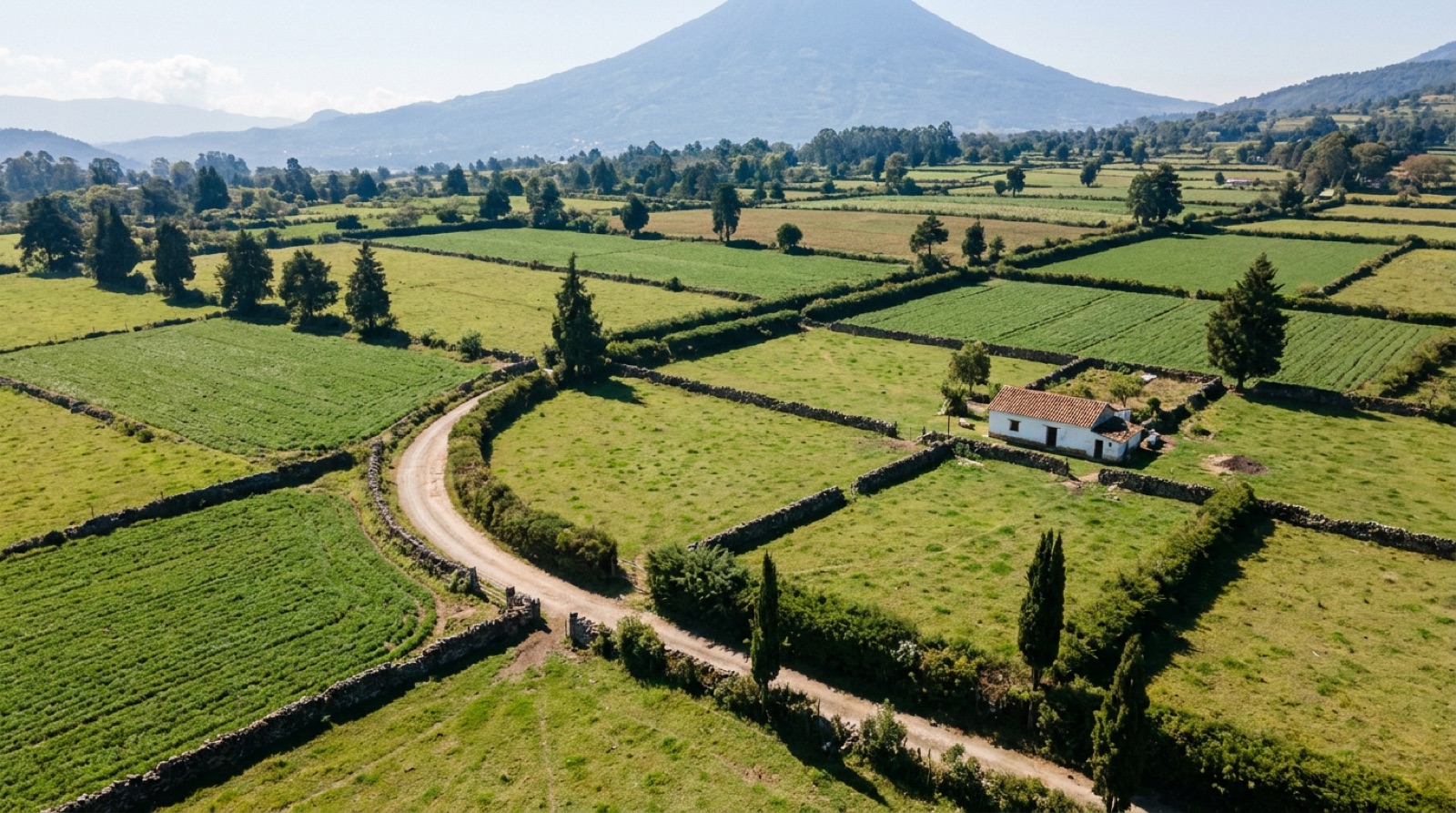
If you’ve looked at a property listing in Antigua Guatemala, you’ve seen measurements that make no sense in feet or acres: varas, manzanas, and caballerías. A listing might read “20 x 30 varas” for an urban lot, or “3 manzanas” for a parcel of land outside town.
These are the units Guatemalan sellers, notaries, and municipal offices actually use. Learn them once and you’ll read every listing correctly — and catch the expensive mistakes that trip up foreign buyers.
What is a vara?
A vara is a traditional Spanish unit of length still used across Guatemala. One vara equals 0.8359 meters, or about 2.74 feet — roughly the length of a yardstick.
In practice, urban property in Antigua is measured in varas. A common colonial lot in the historic center might be listed as 20 x 30 varas, which converts to about 16.7 x 25 meters (roughly 55 x 82 feet). Multiply the two and you get the area:
- 20 × 30 varas = 600 square varas
- 600 × 0.6989 m² = 419 m² (about 4,510 square feet)
That’s a typical Antigua city lot — enough for a narrow colonial home with an interior courtyard.
What is a manzana?
A manzana literally means “apple,” but in Guatemalan real estate it’s a unit of area, used for larger parcels of land, farms, and property outside the city core. It’s short for manzana de terreno.
1 manzana = 10,000 square varas = 6,988.96 m²
In units you already know:
| Unit | Equivalent |
|---|---|
| 1 manzana | 6,988.96 m² |
| 1 manzana | 0.699 hectares |
| 1 manzana | 1.727 acres |
| 1 manzana | about 1.9 US football fields |
So when a listing outside Antigua says “2 manzanas,” you’re looking at about 1.4 hectares or 3.45 acres of land.
What is a caballería?
A caballería is the largest of the traditional units, used for farms (fincas), coffee plantations, and large rural estates. It’s an old colonial measure originally meaning “the land one horseman could work.”
1 caballería = 45.1 hectares = 111.4 acres
That’s about 64.5 manzanas. When you see a coffee finca or a large country property listed in caballerías, the numbers add up fast — a 2-caballería finca is over 220 acres.
Conversion table: Guatemalan units to metric and imperial
| Guatemalan unit | Meters / m² | Acres | Hectares |
|---|---|---|---|
| 1 vara (length) | 0.8359 m | — | — |
| 1 square vara | 0.6989 m² | — | — |
| 1 manzana (area) | 6,988.96 m² | 1.727 | 0.699 |
| 1 caballería (area) | 451,000 m² | 111.4 | 45.1 |
| 1 acre | 4,046.86 m² | — | 0.405 |
| 1 hectare | 10,000 m² | 2.471 | — |
Working backwards: to convert acres to manzanas, divide by 1.727. So 10 acres is about 5.8 manzanas. To convert hectares to manzanas, multiply by 1.43 — 5 hectares is about 7.2 manzanas.
Why do these measurements matter when buying?
Three reasons, all practical and all expensive to get wrong.
1. Price comparison. A lot listed at “$180,000, 1 manzana” is about $2,575 per 100 m². A lot at “$150,000, 8,000 square varas” is about $2,685 per 100 m² — the “cheaper” listing is actually more expensive per square meter once you convert. Without converting, you can’t compare anything.
2. Boundaries and the deed. Guatemalan property deeds describe land using these units. If the deed says one thing and the listing says another, the deed wins — every time. Always confirm the measurement on the registered deed (escritura) matches what the seller is advertising before you make an offer. This is where a good property due diligence process pays for itself.
3. What you can actually build. Municipal zoning and construction rules work in meters and square meters, not varas. A lot’s building footprint, setbacks, and permitted height are all calculated metrically. If you’re planning a custom home build or a renovation, you’ll need the metric area — not the varas figure from the listing.
Common mistakes foreign buyers make
Assuming a “manzana” is a city block. In Guatemala City and Antigua, a manzana can colloquially mean a city block (which is why the word is confusing). In rural property listings, it always means the 6,988.96 m² unit. Context is everything — read the listing carefully.
Confusing varas and square varas. A lot “30 varas deep” (length) is not the same as “30 square varas” (area). One is a side of the rectangle; the other is a tiny patch of land. Listings mix them constantly.
Not measuring on the ground. Paper measurements and physical measurements don’t always match — old colonial properties in particular have crept, been subdivided informally, or absorbed a neighboring strip over the decades. Before closing, have the property physically surveyed (medición topográfica) and confirm the fences match the deed.
Forgetting which region’s vara applies. Guatemala uses the standard vara of 0.8359 m. If you’re looking at old documents from elsewhere in Central America, the vara value can differ slightly. For all practical Antigua purchases, use 0.8359 m.
How to use this when you’re looking
Ask every seller and agent for the metric measurement alongside the traditional one. A transparent seller will give you both. Then:
- City lot in Antigua? Expect varas. Convert to m² and compare price per m² across listings.
- Land outside town or a finca? Expect manzanas or caballerías. Convert to hectares or acres so you can compare with investment property back home.
- Always cross-check the deed. The registered escritura is the only measurement that legally counts.
The Bottom Line
Guatemalan land measurements come down to three numbers to memorize: 1 vara = 0.84 m, 1 manzana = 0.699 hectares (1.73 acres), and 1 caballería = 45.1 hectares (111 acres). Master those and you can evaluate any Antigua Guatemala listing at a glance — and spot a bad deal before it costs you.
The metric conversion is simple. The hard part is knowing which number on which document is the one that actually matters — and that’s where local experience is worth every quetzal.
Ready to Find Your Property?
Browse our available properties in Antigua Guatemala, or contact Luna Jerney for help evaluating a lot, finca, or colonial home. We’ll walk you through the deed, the measurements, and what the land is actually worth — before you make an offer.
Interested in Antigua Real Estate?
Whether you're looking to buy, rent, or invest — I can help. Free consultation, no pressure.