
Water Storage and Rainwater in Antigua Guatemala
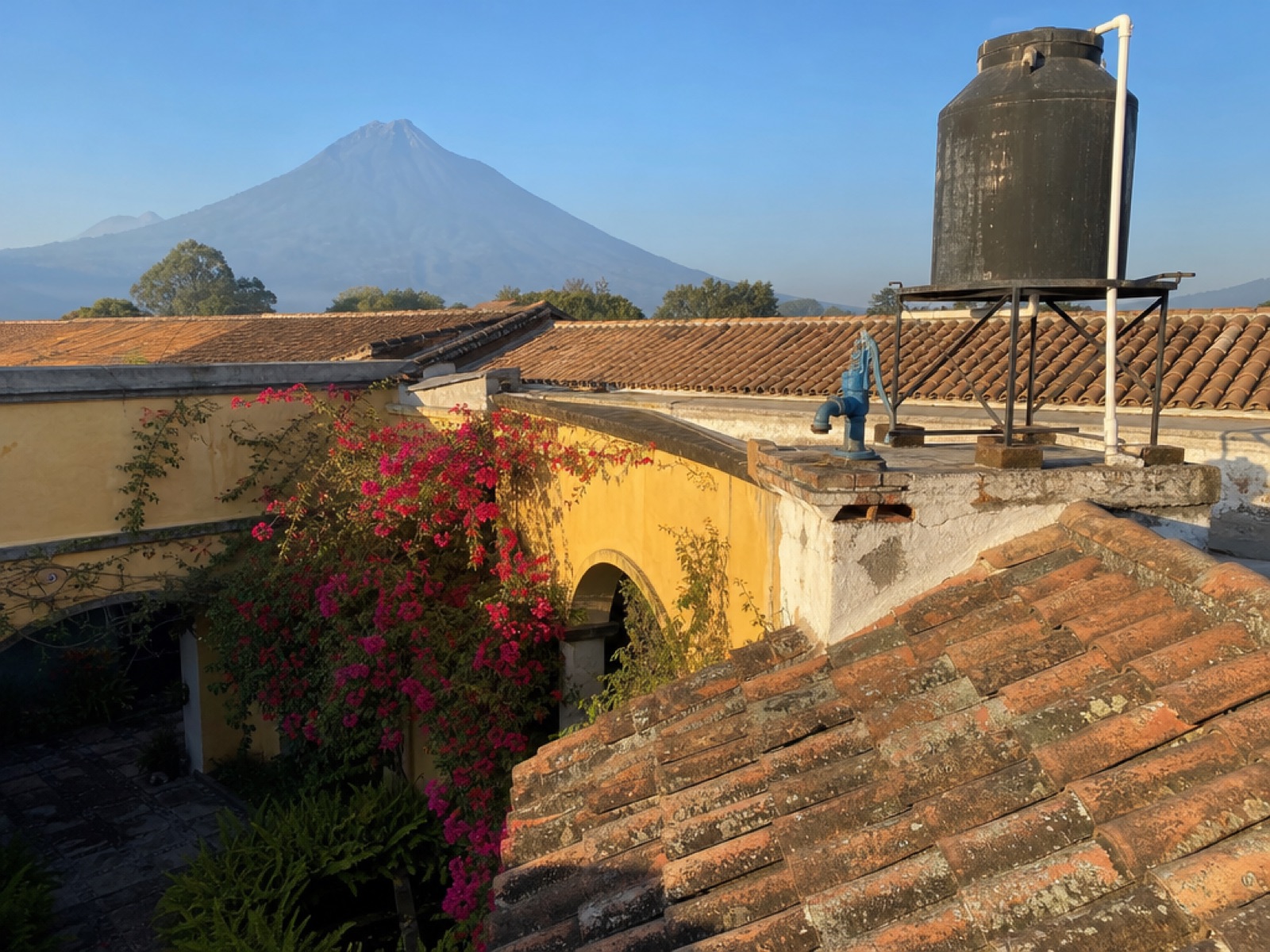
Most homes in Antigua Guatemala store their own water. Municipal supply from EMPAGUA runs to a schedule rather than around the clock, and the dry season from November to April thins both the source and the pressure, so every serious house has a tank, a cistern or both. The storage you buy decides how the whole house feels in March.
Why do Antigua Guatemala homes store their own water?
Water from EMPAGUA arrives in a scheduled window each day, or on certain days, not as a continuous stream. A house fed only from the street main loses water the moment the schedule ends or the pressure dips. Antigua sits at 1,530 metres, and the dry season runs roughly November through April with little rain, so demand on the same supply rises just as it thins.
The fix is always the same: store water when it comes, use it when you want. A gravity tank on the roof plus a pump covers most houses. The only questions are how much storage and where it goes.
How much water should a house store?
One person uses roughly 100 to 150 litres a day. A family of four with a garden can pass 600 litres a day in the dry season. A 1,100-litre tinaco covers one to two days for a small household. A 2,500-litre tank buys three to four days and is the usual choice when a house has a garden or a pool. For a long dry spell, or a rental that cannot go without water, an underground cistern of 5,000 litres or more is the safe figure. Work out daily use first, then buy two to three days of it.
Tinaco, aljibe or pila: what is the difference?
A tinaco is the black or beige plastic tank you see on nearly every roof in Antigua, usually 1,100 or 2,500 litres, on a metal stand or a concrete platform. It is cheap, easy to replace and quick to install.
An aljibe or cisterna is an underground tank, often built from block and sealed with a waterproof render, holding 5,000 to 20,000 litres. It stays cool and out of sight, needs a pump to serve the house, and costs several times a tinaco.
A pila is the old colonial washing basin and small tank in the patio, usually with a stone or concrete surround. Restored, it works as a second water point and stays a heritage feature of the house.
Can you harvest rainwater in Antigua Guatemala?
Yes, and the roof was practically built for it. A clay tile roof sheds almost all the rain that lands on it. A 100 m² roof in a normal year collects well over 100,000 litres, far more than most houses can store, so the limit is cistern space, not rainfall.
The practice matters more than the volume. Divert the first flush of each storm away from the tank, because the opening minutes carry dust, leaves and droppings off the tiles. Screen the inlet, clear the gutter before the rains arrive, and cover the tank fully. Rain is soft and good for plants, but for drinking you still filter or buy purified water, since stored rainwater is not treated.
Households that install a 5,000-litre cistern and a first-flush diverter usually cut their dependence on EMPAGUA and on bought water noticeably through the wet months, then draw on the store in the dry ones.
How much does water storage cost in Antigua Guatemala?
Prices verified in October 2026. Figures are supply and installed unless noted, and material alone is roughly half.
| Item | Price (Q) | Price (USD) |
|---|---|---|
| Tinaco 1,100 L with stand, installed | Q2,500 to Q6,000 | $320 to $770 |
| Tinaco 2,500 L with stand, installed | Q5,000 to Q9,000 | $640 to $1,150 |
| Underground cistern, 5 m³, built and sealed | Q12,000 to Q30,000 | $1,540 to $3,850 |
| Restore a colonial pila | Q3,000 to Q9,000 | $385 to $1,150 |
| Booster pump and pressure tank, installed | Q2,500 to Q8,000 | $320 to $1,030 |
| Rainwater downpipe and first-flush diverter, per roof section | Q1,200 to Q3,500 | $155 to $450 |
| Built tank platform or stand | Q1,500 to Q4,500 | $190 to $580 |
| Annual tank cleaning and disinfection | Q400 to Q1,200 | $50 to $155 |
Prices convert at about Q7.8 to the dollar.
Does a rooftop tank need permission?
A tinaco tucked on the rear roof or over the courtyard is rarely a problem. A tank, pump housing or pipe run that is visible from the street sits inside the heritage rules for Antigua’s protected centre, where changes to what the street sees need a municipal licence with the heritage office (CNPAG) giving an opinion. The least regulated option is to place the tank where it cannot be seen from the pavement, or to keep an existing stand and replace only the tank on it. If you are buying a house with a tired tank on the front roofline, moving it to the rear is often simpler than replacing it where it stands.
Keeping stored water clean
A tank is a living thing. Clean and disinfect it once a year, and more often if the water smells or the lid sits loose. Keep the lid tight and the outlet screened so nothing crawls in. Draw off sediment from the bottom drain at the end of the dry season if the tank has one. If you filter drinking water, the tank is the first stage, not the last: read our guide to water quality and filtration for what comes next.
What to check before you buy
- Count the storage: how many litres in total, and is it two to three days of the household’s use?
- Test the pump, and confirm pressure at the top-floor tap on a dry-season morning.
- Look at the tank itself: age, cracks, a lid that fits, a stand that is not rusted through.
- Find the overflow: does it discharge onto your own land?
- For an aljibe, look for damp and a working hatch you can clean through.
- Ask when the tank was last cleaned and disinfected. If nobody knows, assume it has not been.
If storage is thin, it is one of the cheapest first projects a house can take on, and it changes daily life immediately. Wiring and pipework usually need attention at the same time; see our notes on plumbing and water pipes in Antigua homes.
Our team walks a property with you before you commit and prices the storage fix along with it. Send us the address and we will tell you plainly what the water situation looks like, through the dry season and out the other side. Talk to us, or browse current listings with the water question in hand.
Interested in Antigua Real Estate?
Whether you're looking to buy, rent, or invest. I can help. Free consultation, no pressure.