Accessible Living in Antigua Guatemala: A Guide
Antigua Guatemala is more accessible than its cobblestones suggest, but it is not fully barrier-free. The historic centre is flat and compact, most colonial houses are single-storey with the main rooms on one level around a courtyard, and medical care and household help are close by and affordable. What you do have to plan around are the street surface, the step at the front door, and the narrow bathroom and bedroom doors of an older house. This guide covers what works here, what does not, and what it costs to adapt a home.
Is Antigua Guatemala accessible for people with mobility needs?
Partly, and honestly so. The street layout helps: the centre is a flat grid about twelve blocks across, built for walking, so most daily errands sit within a few minutes of each other. The housing stock helps even more, because the traditional colonial house is single-storey. What does not help is three hundred years of volcanic-stone paving, narrow raised sidewalks with few kerb ramps, and older homes with steps and tight doorways. People who use a wheelchair, a walker or who tire easily do live in Antigua, and they make it work with a carefully chosen house and a car or tuk-tuk for longer trips rather than by expecting a barrier-free city.
What are the streets and sidewalks really like?
Most streets in the centre are cobbled with uneven volcanic stone, which is rough under wheels and hard on a walker. Sidewalks are narrow, often lifted by tree roots, and many carry a step up from the road with no ramp. A handful of central streets have been resurfaced smooth in concrete or adoquín, so which block you land on matters. The comfort is that the centre is small, distances stay short, and a tuk-tuk costs about Q5 to Q15 for a hop across town, which softens the problem considerably.
Why do colonial homes often suit limited mobility better than a modern one?
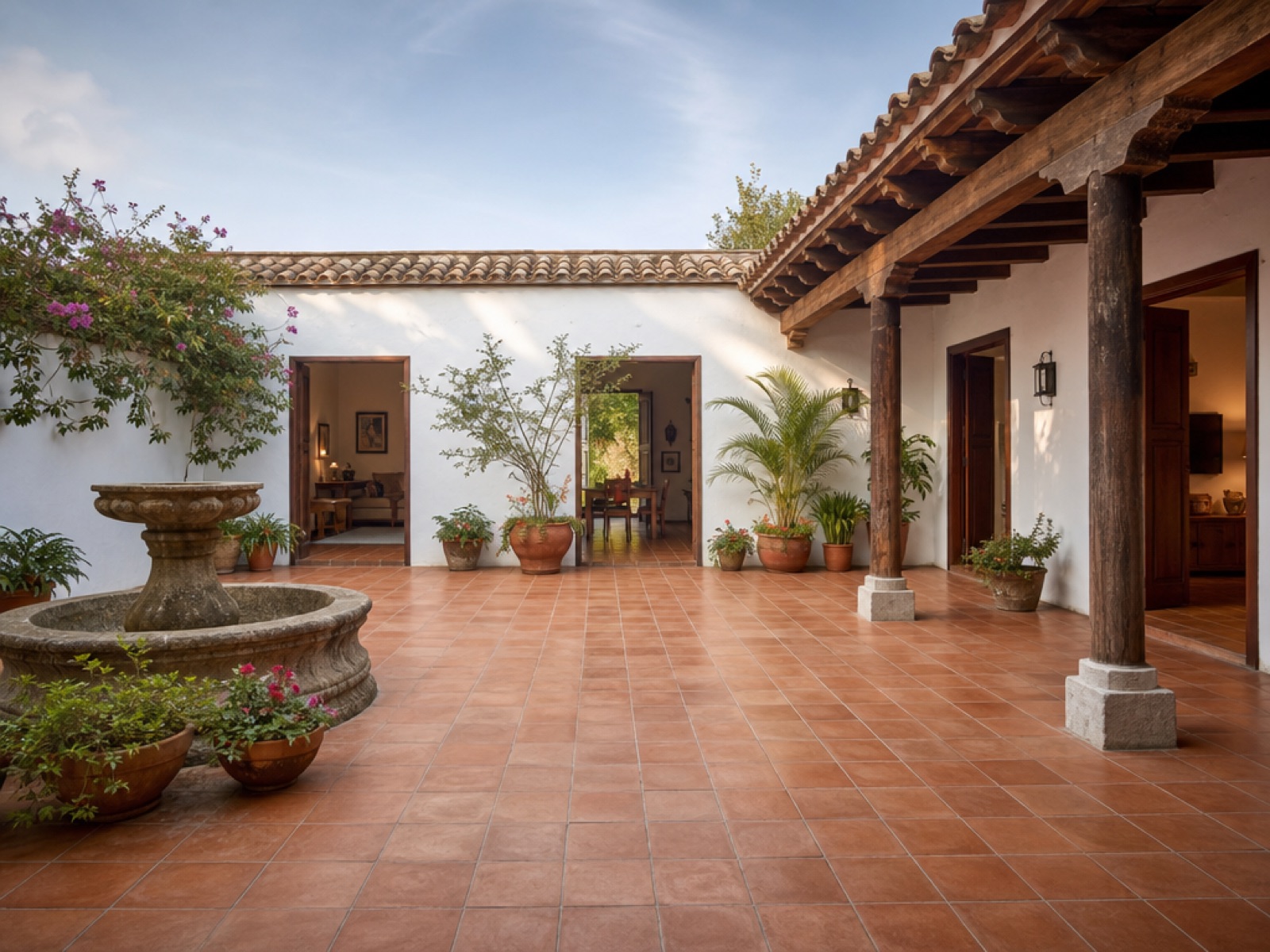
The single-storey plan is the main advantage. In a traditional colonial house, bedrooms, kitchen and living rooms all open off a level courtyard, so there is no staircase to the rooms you use daily. Entrance doorways through the zaguán are generous, ceilings are high, and the thick masonry walls take a handrail or a grab bar wherever you need one. The catch is in the older detail: a step up from the street, raised thresholds between patio and rooms, bathroom doors around 60 to 70 cm wide, no grab bars, and polished floors that turn slippery in the wet season. An azotea or a second-level room means stairs, so treat those as storage rather than a bedroom. If you need a wet room reworked, our kitchen and bathroom guide covers what the work involves.
What does it cost to adapt a home for mobility?
These are 2026 supply-and-install figures for work in Antigua, in quetzales with a US dollar equivalent. Costs vary with the house, the materials and how much of the existing fabric has to be moved.
| Adaptation | Typical 2026 cost |
|---|---|
| Concrete ramp at the front entrance, 2 to 3 m | Q3,500 to Q9,000 ($450 to $1,170) |
| Widen one interior doorway | Q2,500 to Q6,000 ($320 to $780) |
| Grab bars in a bathroom, set of three installed | Q900 to Q2,500 ($115 to $325) |
| Convert a bathtub to a curbless walk-in shower | Q6,000 to Q18,000 ($780 to $2,340) |
| Handheld shower on a slide rail | Q450 to Q1,200 ($60 to $155) |
| Non-slip tile in a bathroom or patio | Q150 to Q400 per m2 ($20 to $52) |
| Handrail on an existing step or short stair | Q800 to Q2,500 ($105 to $325) |
| Convert a ground-floor room to a bedroom with an accessible bathroom | Q25,000 to Q70,000 ($3,250 to $9,100) |
Is healthcare and daily help within reach?
Everyday care is close. Antigua has clinics, laboratories and private practices, and the hospitals and specialists of Guatemala City are about 45 minutes away. Our healthcare guide for expats lists what is available and what it costs. Daily help is the other half of living here comfortably: housekeeping, cooking and personal-care assistance are common and affordable, and households routinely build a routine around a housekeeper who comes several days a week. Hiring domestic help explains the going rates and how the arrangement works.
How do you get around without a long walk?
Most people with limited mobility keep a car and choose a house where a vehicle can stop close to the door, which is why parking matters more here than it might at home. Our parking guide explains the marbete permit and which sectors can take a garage. Tuk-tuks and taxis fill the gaps for short trips, and a private driver for a few hours a day is inexpensive by North American or European standards. If stairs are what you want to avoid entirely, a modern condo with a lift is worth a look, and the condo market here is small but real.
What should you check before you buy?
- A ground-floor bedroom and a full bathroom on the same level, confirmed in person and not taken from the listing.
- The number and height of the entrance steps, and whether a ramp fits without touching the street facade, the one change that may need a municipal permit.
- Doorway widths: measure the bathroom and bedroom doors, since 80 cm is comfortable and 60 cm is not.
- Whether the whole courtyard and the rooms you use daily sit on one level.
- The street surface right outside the door, because a smooth repaved block is a different experience from rough stone.
- Distance to a clinic, a pharmacy and a supermarket, walked at your own pace and not the seller’s.
How do we help?
Bring us your daily needs rather than a fixed idea of the house. We filter listings for ground-floor bedrooms, level courtyards and easy vehicle access, confirm what a property actually has before you travel, and coordinate contractors and any adaptation work through to completion. Start with what is for sale now, or write to us and tell us what a normal day needs to look like.
Interested in Antigua Real Estate?
Whether you're looking to buy, rent, or invest. I can help. Free consultation, no pressure.