
How Noisy Is Antigua Guatemala? A Buyer's Guide
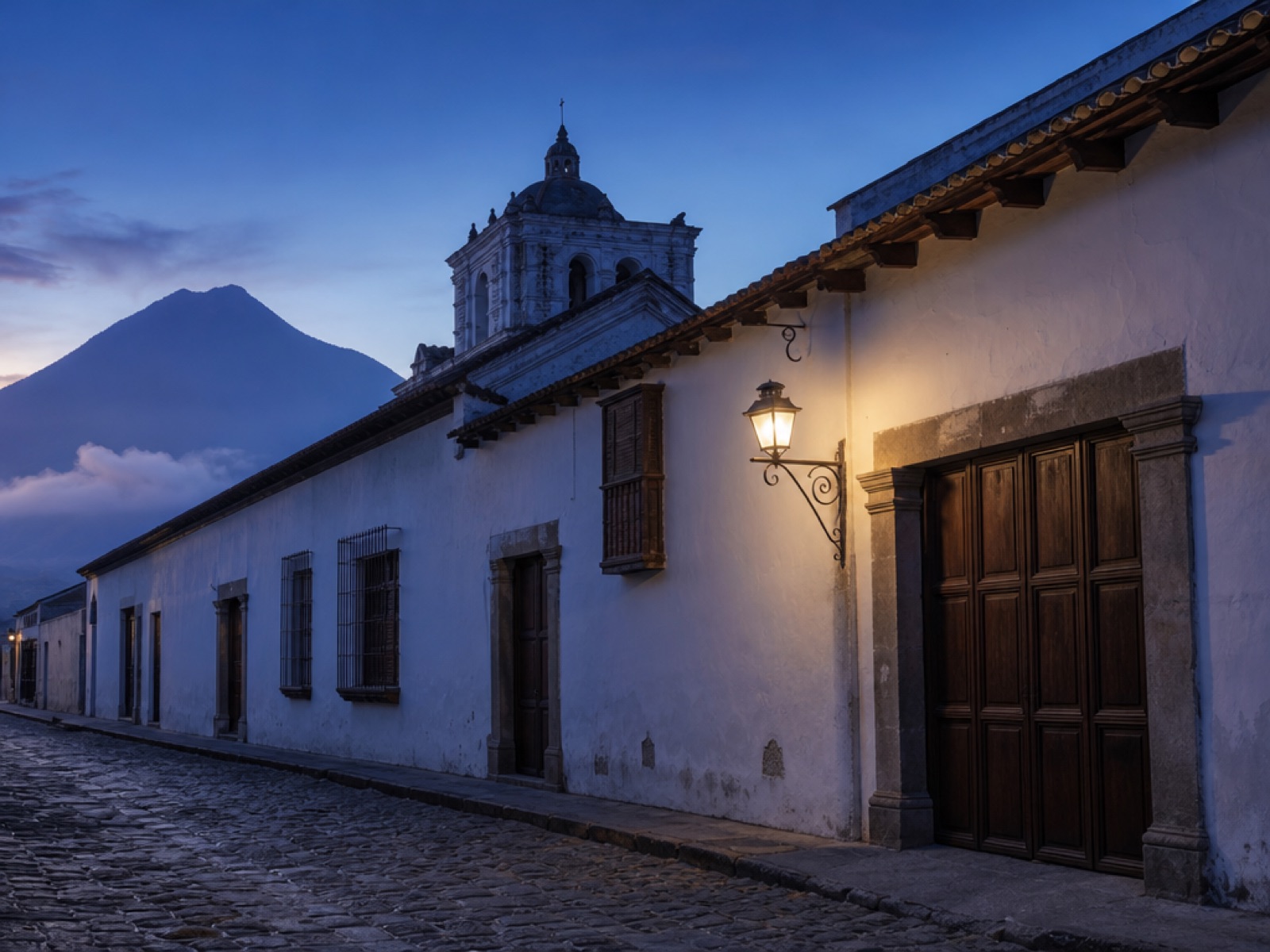
Antigua Guatemala is quiet by Latin American standards, but not silent. The sounds you live with are cohetes (fireworks), church bells, tuk-tuks and motorbikes on cobblestones, renovation work and weekend music. What decides whether you sleep well is not the town. It is the street you buy on and where the bedroom sits inside the house.
What noises will you actually hear in Antigua Guatemala?
Antigua has no constant city roar, just a set of repeatable sounds. Cohetes, the aerial fireworks used in festivals and processions, go off at any hour and carry across the whole valley. Church bells ring from five in the morning and again through the day, and several churches sit within blocks of the Parque Central. Tuk-tuks and older motorbikes are louder than the cars, and cobblestones amplify every tyre. Renovation work is constant, loudspeaker trucks announce the gas, water and rubbish rounds, and weekend music fills the centre.
| Noise | When it happens | How far it reaches | What actually helps |
|---|---|---|---|
| Cohetes (fireworks) | Festivals, processions, any hour | The whole valley (aerial) | Nothing. Distance is the only remedy |
| Church bells | From about 5 am, then all day | Three to four blocks | A bedroom on the courtyard |
| Tuk-tuks and motorbikes | Day and evening | One to two blocks | Heavy door, shutters, a second pane |
| Cobblestone traffic | Early morning and late evening | The street itself | A room facing the patio |
| Renovation work | Weekday mornings, often from 7 am | Neighbouring houses | Agreed working hours |
| Loudspeaker trucks | Fixed daily rounds | The block | Little; it passes in minutes |
| Bars and live music | Thursday to Saturday, late | The bar street | Secondary glazing, or buy two streets away |
Almost none of it is continuous. A cohete is over in seconds, the gas truck is gone in minutes, and what wears people down is the noise that repeats.
How loud is Antigua Guatemala, and what do the rules say?
Antigua has its own municipal sound regulation. It sets a night limit of around 40 decibels at the property line, quieter than a normal conversation, plus interior maximums by venue type: about 60 decibels for a restaurant, 75 for a bar and 85 for a club. In practice the rules bite when somebody complains, not when someone patrols with a meter at night. Under the Código Municipal the municipality can fine anyone operating sound equipment or megaphones without a licence, from Q500 up to Q50,000, and the traffic law fines a bad exhaust at about Q200 and strident horns at about Q300. (Rules checked November 2026.)
If a bar, restaurant or workshop is the problem, complain to the municipal office with a date, a time and a short video, and ask whether the venue holds an Establecimiento Abierto al Público licence. An unlicensed venue is your strongest lever, because that is a legal problem rather than a matter of taste. After hours, call the Policía Nacional Civil.
Which parts of Antigua Guatemala are the quietest?
The loudest blocks are those within two or three streets of the Parque Central and the bar streets, where fireworks, nightlife and foot traffic pile up. A block or two off the through-routes the centre calms noticeably, and the peripheral barrios, San Felipe, San Pedro El Alto and the edges of Jocotenango, are quieter still without losing the walk into town. Our guide to the best neighborhoods in Antigua Guatemala maps those trade-offs street by street.
The villages go further. El Hato, San Juan del Obispo and Ciudad Vieja are rural enough that you hear birds instead of traffic, and Ciudad Vieja is quieter and cheaper than Antigua while keeping its own market and restaurants. The caveat: quiet is not silence anywhere in this valley. Every village has its own bells and festival cohetes, and a plot beside a farm brings roosters and dogs. For the quietest option on the market, a gated community outside town usually wins.
How do you check a house for noise before you buy it?
- Visit the exact street three times: a weekday at 6 am, a Friday or Saturday at 10 pm, and during a festival if you can.
- Stand where the bed would go, close the door and listen. Distance inside the house matters more than the street.
- Count the churches within four blocks, then ask whether a procession route passes the door. Processions are the loudest event of the year and the rarest.
- Look along the block for a bar, a restaurant kitchen, a carpentry workshop or a herrería, all of which start early.
- Ask the neighbours, not the seller, and see the property viewing checklist for the rest of the walkthrough.
What can you do to quiet a colonial house?
The colonial fabric helps more than you would expect. Walls of 40 to 80 cm of adobe absorb sound, so a thick-walled house on a busy street hears far less than a modern block building next door. The weak points are the openings and the interior partitions: a single-glazed wooden window lets noise straight in, and the light bahareque walls between rooms carry it to the bedroom.
The fixes, at typical 2026 supply-and-install prices, are a solid hardwood exterior door (Q2,500 to Q9,000), an interior wooden door (Q1,200 to Q3,000), repairing a wooden window (Q400 to Q1,200), secondary glazing (Q1,200 to Q3,500 per opening), an acoustic curtain (Q400 to Q1,500) and raising a perimeter wall by 50 cm (Q250 to Q450 per linear metre). Our guide to windows and doors in colonial homes explains how each interacts with the heritage rules on the street facade.
The cheapest fix costs nothing. In a courtyard house the street facade is often a single wall and the bedrooms open onto the patio, so that layout removes most of the problem before you spend a quetzal.
What can no amount of money fix?
Cohetes and church bells. Both arrive from above, so no wall, gate or window stops them, and distance is the only remedy. That is why the outer barrios and villages exist as an answer to this question at all. A busy street can be reduced but never fully silenced, and a licence-holding bar on your block is lawful and you will be living with it.
Who should think twice about the historic centre?
If you are a light sleeper, work night shifts, take calls on a fixed schedule from another time zone, or have a baby who needs predictable naps, the centre will test you. Buy in a peripheral barrio or a village instead, and visit the centre when you want it.
Tell us how you sleep and how you live and we can steer you to the streets that match. Talk to Luna Jerney and the team at Antigua Real Estate Development and we will walk your shortlist at the hours that matter, not the hour that flatters a house. Browse properties for sale or our services.
Interested in Antigua Real Estate?
Whether you're looking to buy, rent, or invest. I can help. Free consultation, no pressure.