
Water Wells in Antigua Guatemala: Cost and Rights
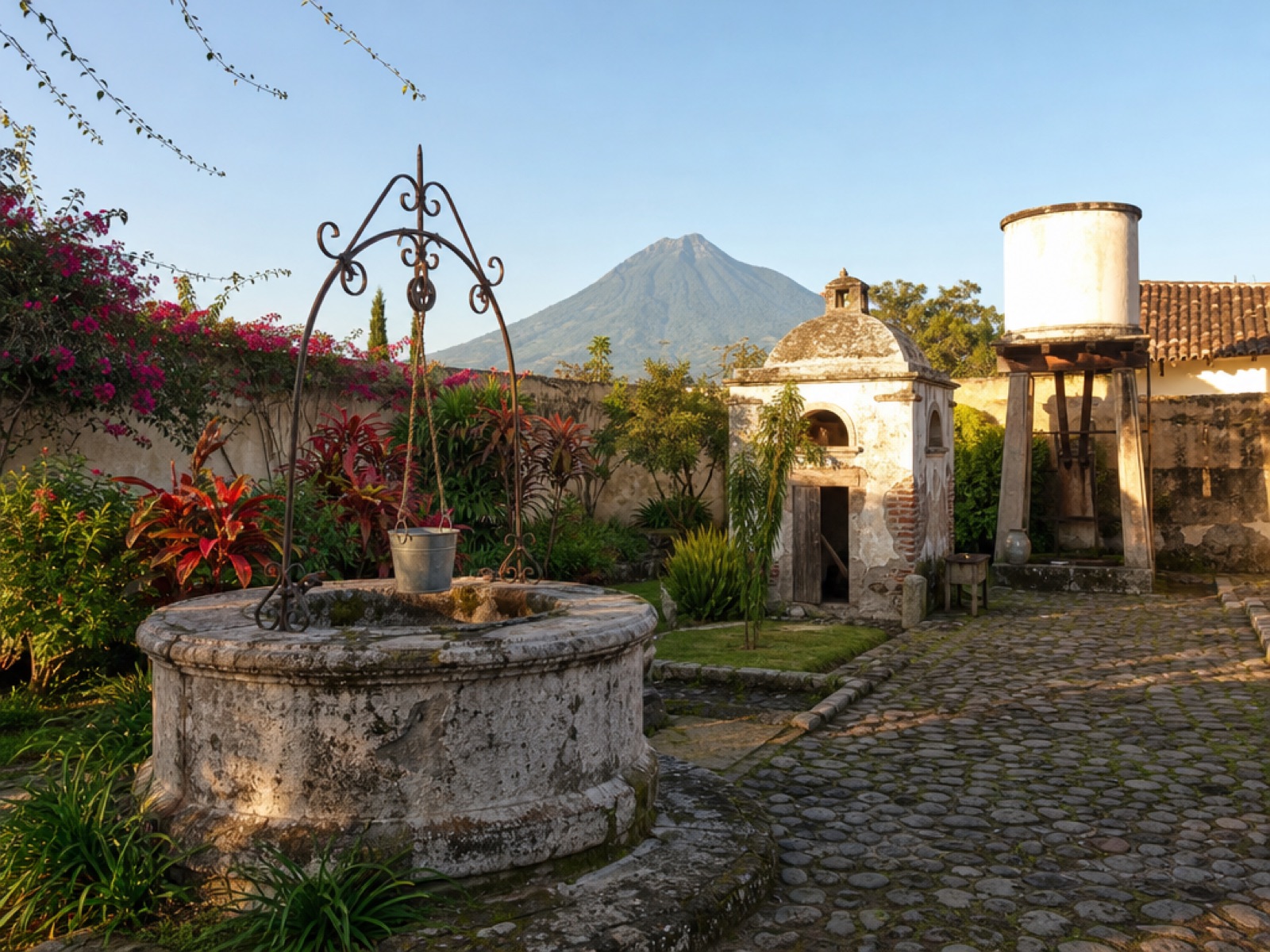
Most homes inside Antigua Guatemala run on the municipal network, EMPAGUA, which arrives by schedule rather than around the clock and is usually topped up by a tinaco or a cisterna. A well enters the picture only when a property sits outside that network: land on the edge of town, a finca in the hills, a plot in one of the ring villages, or a large garden and pool that a scheduled supply cannot keep up with. If you are buying any of those, the well is not a small detail. In rural Antigua, legal access to water is often worth more than the land itself.
When does a property actually need its own well?
Most houses in the colonial centre never need one. The municipal line reaches them, and a tank does the rest. A well becomes necessary in four situations:
- The plot sits outside EMPAGUA coverage, on a finca road, in a ring village, or on land beyond the paved grid.
- The house carries a large garden, a pool, or a guest casita that a by-schedule supply cannot serve.
- Pressure at the end of the line drops low enough in the dry season to be a daily problem.
- The owner simply wants to stop depending on a schedule, and treats the well as a backup.
The trade is straightforward. A well ties up money up front and needs testing, servicing and a legalisation file, but it ends the dependence on when the tanker or the municipal line shows up.
How much does it cost to drill a well in Guatemala?
The figures below are typical 2026 quotes from drilling contractors and pump installers around Antigua. Depth, the rock the drill meets, and how far the electricity has to reach move the total more than anything else. Treat each row as a stand-alone answer: a well drilled to 40 metres in soft ground is not the same project as one taken to 100 metres through hard rock.
| Item | Typical 2026 range |
|---|---|
| Hydrogeological survey, if the site is unproven | Q1,500 to Q6,000 ($200 to $770) |
| Drilling, per linear metre | Q400 to Q900 ($50 to $115) |
| PVC casing and screen, per metre | Q200 to Q450 ($25 to $60) |
| Submersible pump and installation | Q4,000 to Q15,000 ($520 to $1,930) |
| Pressure tank or booster | Q2,500 to Q8,000 ($320 to $1,030) |
| Electrical drop to the pump | Q2,000 to Q6,000 ($260 to $770) |
| Water quality test | Q500 to Q1,500 ($65 to $190) |
| Permit and legalisation | Q3,000 to Q12,000 ($390 to $1,550) |
| Complete well, 40 to 60 metres, ready to use | Q35,000 to Q120,000 ($4,500 to $15,500) |
Prices verified against contractor quotes in the Antigua area in 2026. Depth is the biggest variable: a metre of drilling is cheap next to the pump and casing a deep hole needs.
How deep are wells around Antigua, and will it produce water?
Depth is local. On the valley floor around town, wells often land between 20 and 60 metres. On higher ground, in the hills, and in some ring villages, the drill may need 60 to 120 metres before it reaches a reliable aquifer. A few very old courtyards still carry a hand-dug pozo de brocal, five to fifteen metres deep and too shallow for a modern household.
Depth alone does not tell you whether a well works. Yield does. A household of four needs a few litres per minute sustained through the day; a property feeding a garden and a pool needs considerably more. The honest test is the yield measured at the end of the dry season, from November to April, not in September when the aquifer is full. If a seller tells you the well is good, ask when it was last measured and in which month.
Do you need a permit to drill a well in Guatemala?
Yes. Groundwater is regulated, and an unregistered well is a problem at resale and a real risk if a neighbour disputes the water. In practice a legal well involves a municipal authorisation, a water-use licence from the national environment ministry, MARN, and the legalisation of the works once they are done. Some zones are restricted or closed to new drilling, and that status can change.
This is not a place to improvise. Work through a lawyer who handles water permits, insist on seeing the legalisation documents before you buy, and never accept land that “has water” on word of mouth alone. The paperwork, not the hole in the ground, is what protects the asset.
Is well water safe to drink?
Test it rather than assume. Highland groundwater around Antigua is often good, but it can carry iron, hardness or bacteria, especially in a shallow or hand-dug well near a septic system. A laboratory test costs Q500 to Q1,500 and tells you exactly which treatment you need, from a simple sediment and carbon filter to softening or disinfection. Test first, then buy the equipment that matches the result. Our guide to water quality and filtration covers the options in detail.
How a well fits with a tinaco or a cisterna
Even with a well you still want storage. The well replaces the municipal feed, not the tank. A tinaco or cisterna holds the buffer so the pump is not switching on every time someone opens a tap, and a pressure tank keeps the flow steady. If you are planning the whole system, our post on water storage and rainwater sets out the sizes and the costs, and the utilities guide covers how water reaches a house in the first place.
What to check before buying a property that depends on a well
- Ask for the legalisation file and the water-use licence, and read them.
- Run the pump and time how fast it recovers, then watch the pressure gauge.
- Get an independent water test before you commit, not after.
- Check the circuit and panel capacity that feed the pump, since an old panel is a common weak point.
- Ask whether neighbours draw from the same aquifer, and whether any well nearby has gone dry.
- Find out when the pump, casing and pressure tank were last serviced.
Buying land is a separate subject, and we cover the water angle in more depth in our guide to buying land in Antigua Guatemala.
The bottom line
A well is a capital cost, usually a four-figure sum in dollars, and a long-term asset. On land outside the municipal network it can be the difference between a property that works year-round and one that limps through the dry season. Verify the water before you verify anything else.
If you are looking at land, a finca or a village property around Antigua and want to know whether the water holds up, talk to us. Start with our current properties, see what we do on the services side, or contact us and we will help you read the file before you commit.
Interested in Antigua Real Estate?
Whether you're looking to buy, rent, or invest. I can help. Free consultation, no pressure.