
Decorating a Colonial Home in Antigua Guatemala
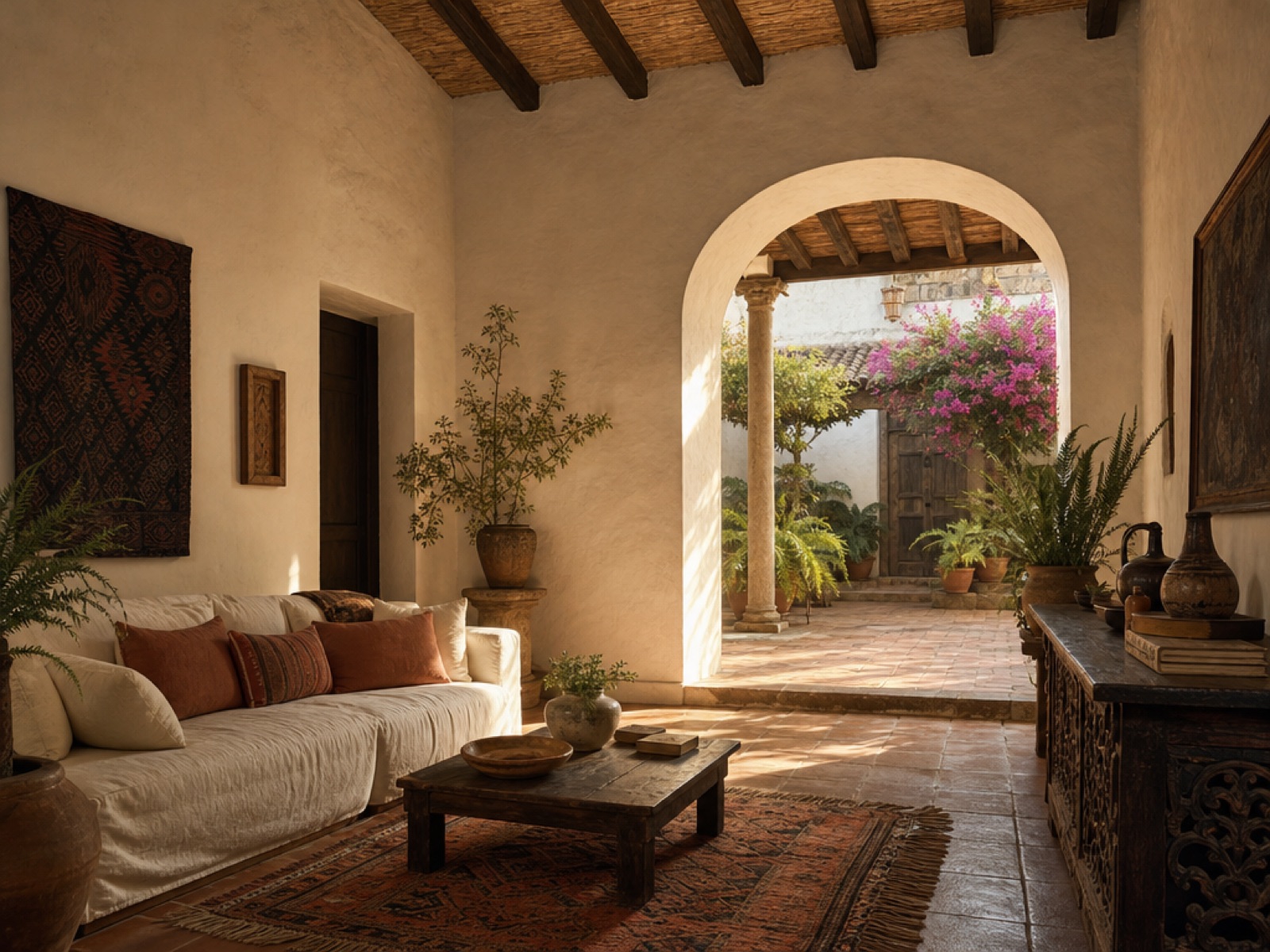
Decorating a colonial home in Antigua Guatemala is less about choosing a style than about working with the building you already own. Walls 40 to 80 centimetres thick and ceilings three to four metres high under wooden vigas decide where furniture can stand, how much colour a room takes and how much light it holds. When the decoration follows those constraints, the house does most of the work for you.
Owners arriving from a city apartment often bring furniture scaled for a smaller room and a palette borrowed from a design magazine, then wonder why the space feels dark. This guide covers the layout, scale, colour and material decisions that suit a colonial interior.
What makes decorating an Antigua colonial home different?
Three features repeat in almost every house inside the colonial grid: thick walls, tall beamed ceilings, and rooms built in a ring around a central patio rather than opening onto the street.
They change the rules in practical ways. Because the walls are so deep, windows sit far back in a reveal and furniture cannot sit flush, so corner pieces rarely fit. Tall rooms swallow compact furniture. Light arrives from one side only, through openings that are small and set high, so corners stay dim even at midday. And the patio, not the street, is where the light and the household life gather.
| Colonial feature | What it does to the room | What to do about it | | Walls 40-80 cm thick, rarely square | Furniture cannot sit flush; deep window reveals | Float pieces off the wall; use the reveals as shelves | | Ceilings 3-4 m under vigas and teja | Tall rooms make small furniture look lost | Raise the scale: tall headboards, long curtains, large art | | Small high windows on one side | Rooms lit from one side, with dim corners | Light palette, a mirror opposite the window, layered lamps | | Barro tile and stone floors, slightly uneven | Thin rugs slide; hard feet scrape and chip the tile | Thick wool rugs with a pad; felt pads under every leg | | Rooms arranged in a ring around the patio | The courtyard is the light source and the real front door | Treat the corredor as the main living space | | Lime-washed or painted plaster walls | Breathable, textured and easy to mark | Choose washable lime or clay paint; plan fixings carefully | | Original rejas, postigos and ironwork | Windows are partly screened by iron and shutters | Furnish around the openings; never hide them |
What furniture scale works in a colonial home?
Big and low at the same time. Colonial rooms reward furniture with presence: a long sofa, a substantial dining table, a tall headboard, a cabinet that reaches most of the way up the wall. A delicate modern set disappears into a room with a three-and-a-half-metre ceiling.
At the same time, keep the sightlines low. In a bedroom with a low window, a tall wardrobe blocks the only light the room has. In a sitting room, a sofa pressed against the wall leaves the middle empty and awkward. Pull the seating into the room to create a conversation area and let people walk behind it.
Materials matter as much as size. Solid wood, cotton, linen, wool and leather age well against lime plaster and terracotta. Glossy lacquer, chrome and glass read as cold in the dim corners.
What colours and materials suit a colonial interior?
Warm, dusty and low in contrast. The palette that has always worked here comes from the materials themselves: lime-washed off-white, ochre, pale yellow, terracotta, clay, sage, and the deep oxblood reds on doors and window frames around town.
You do not have to paint with them, but the furnishings should sit with them. Cream and bone upholstery, terracotta and rust textiles, dark wood, black iron and aged brass all belong. Cool greys and stark black-and-white schemes look imported, and they go flat in a room lit from one side.
For the walls, the finish matters more than the exact colour. Lime and clay paints let the masonry breathe, which is how this house style survives the rainy season. See painting a colonial home for the local palette.
How do you light a colonial interior?
Layering beats brightness. A single ceiling fixture in a high room leaves the walls dark and the centre over-lit. Instead, combine a pendant or plafón, two wall sconces at about 1.7 metres, a lamp on a console and a floor lamp beside the reading chair, all on warm 2,700 K bulbs so nothing clashes.
Put a light where you actually sit, not where the ceiling happens to be wired, and fit dimmers. The full picture is in lighting colonial homes.
How do you arrange furniture around a courtyard?
The corredor, the covered walkway that runs around the patio, is the room the household actually uses. Furnish it that way: a table and chairs for meals, a bench, a hammock, two or three large planters, and a light you can switch on after dark.
Inside rooms keep their own seating, but the house gravitates to the patio side for most of the day. Treat the courtyard as an extra room rather than a view. Courtyard gardens covers the planting side of that.
What should you keep rather than hide?
Original elements are the reason the house is worth what it is: vigas, teja, barro floors, rejas, postigos and the stone pila. Do not box them in with drywall or drop a suspended ceiling over exposed beams. Decorate around them and let them set the tone. Colonial architecture explains which ones the heritage rules protect.
Where do you buy furniture and decor in Antigua?
Local carpinterías in Antigua, Jocotenango and Ciudad Vieja build solid wood pieces to measure, from beds and dining tables to fitted wardrobes. Textiles, ceramics, rugs and baskets come from the markets and the artisan villages. Guatemala City offers wider choice for upholstery and appliances.
Ordering a container from abroad rarely pays unless the piece is genuinely unique, since local solid-wood work is inexpensive by North American or European standards. The room-by-room budget is in the cost to furnish a home here, and importing household goods covers the container route.
What decorating mistakes do foreign buyers make?
- Scaling furniture to a magazine photo instead of a four-metre ceiling, so the room feels empty.
- Painting every room stark white or cool grey, which reads cold in a single-aspect colonial room.
- Hiding original beams, niches and ironwork behind drywall and dropped ceilings.
- Ignoring the patio, which is the space the household uses most.
- Choosing finishes that trap damp: sealed floors, cement paint on lime walls and fabric that cannot be washed.
If you are furnishing from abroad, buying sight unseen covers how to check a room’s light and proportions in advance.
Browse our available properties to see furnished interiors across the city, or get in touch and we will talk through what suits the house you are considering. Decorating a colonial home is not a matter of importing a look. It is a matter of reading the building and letting it lead.
Interested in Antigua Real Estate?
Whether you're looking to buy, rent, or invest. I can help. Free consultation, no pressure.