
Laundry and Drying in Antigua Guatemala Homes
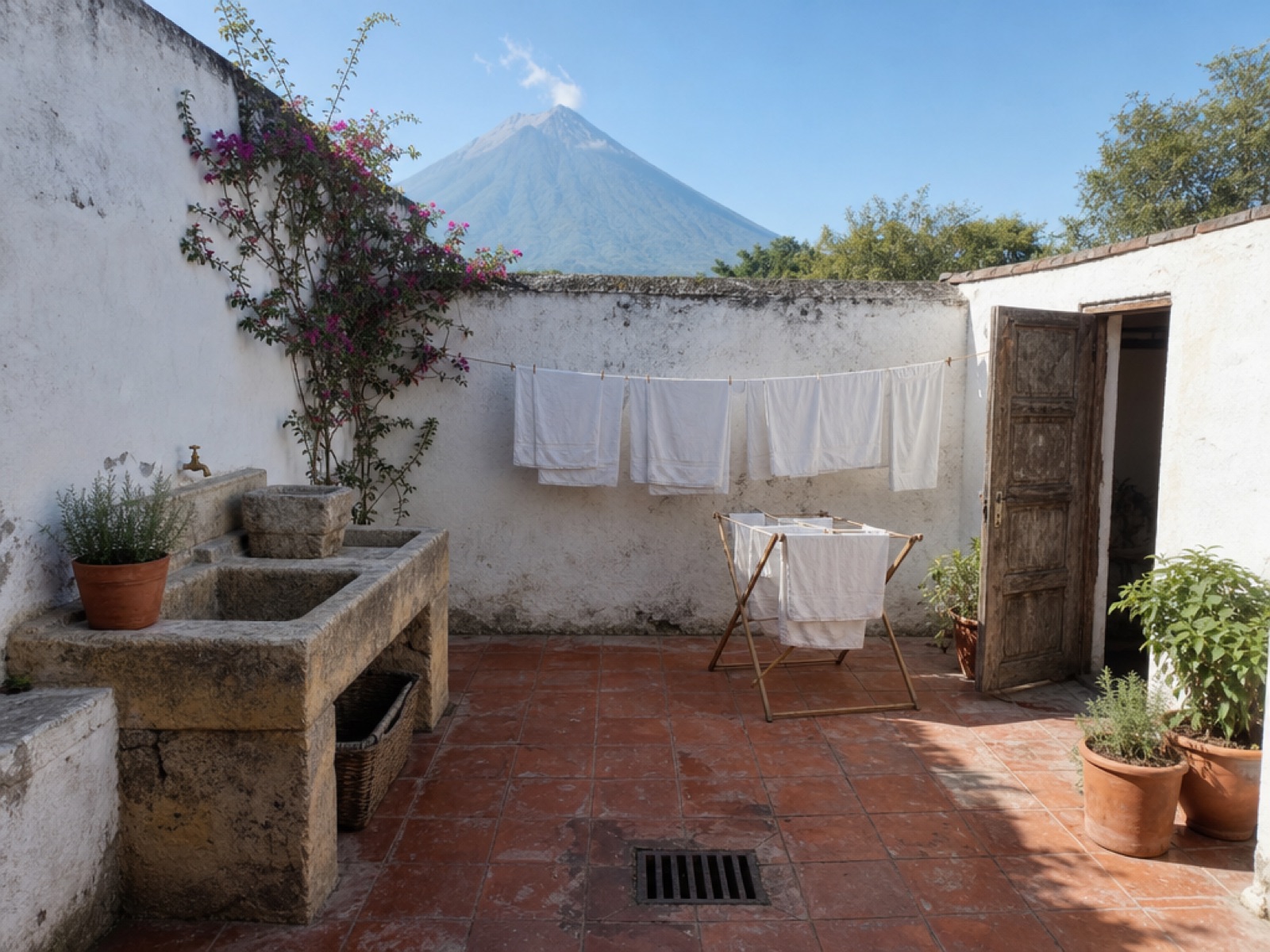
Most homes in Antigua Guatemala wash in a machine and dry on a line, not in a dryer. Nearly every house has a washing machine or at least a lavadero, the stone wash basin built into the service patio, but a tumble dryer is rare. The climate is mild, the sun works for eight or nine months of the year, and electricity runs at Q1.20 to Q2.30 per kilowatt hour, so a dryer is a costly habit rather than a necessity.
Drying becomes the real question in the rainy season, from May to October, when a covered line under the corredor or a small drying room earns its keep. A fitted laundry corner in an existing patio costs Q8,000 to Q25,000 installed in 2026, and converting a small service room into a proper lavandería costs Q20,000 to Q55,000.
Do Antigua Guatemala homes have washing machines and dryers?
Yes to washing machines, rarely to dryers. In a house inside the colonial grid you will find the machine in the patio de servicio or a cuarto de servicio behind the courtyard, next to the pila and the tinaco. Dryers show up mainly in new condominiums and in furnished short-term rentals aimed at guests from colder countries, who expect to pack light and wash mid-stay.
For a long-term owner the local answer is simple: wash inside, dry outside. That is not a compromise. It is the reason many homes never install the second appliance at all.
Where does the washing machine actually go?
Colonial homes in Antigua have no basement and no crawlspace, because of the water table and the earthquake history, and 40 to 80 cm walls give no cavity to run pipes in. So the laundry lives in the service strip at the rear of the patio, as far as possible from the street door and the bedrooms.
Three placements work in practice:
- The service patio. A corner beside the lavadero, under an existing corredor roof. Cheapest and most common.
- The cuarto de servicio. A small room off the courtyard, often used as a bodega. Convert it and you gain a door, a shelf and a place to hide the machine.
- A rear extension. If you are building out anyway, a purpose-built lavandería at the back is the tidiest option.
Whatever you choose, the machine needs three things: a water tap, a drain, and a power point. Adding a tap and a drain line costs Q3,500 to Q9,000 installed, the figure used on the plumbing page.
What does a laundry area cost in Antigua Guatemala in 2026?
These are installed prices, supply and labour, at about Q7.7 to the US dollar. Material alone is roughly half.
| Work | 2026 installed cost |
|---|---|
| Stone lavadero repaired and re-sealed | Q1,200 to Q4,000 |
| Tap and drain added for a washing machine | Q3,500 to Q9,000 |
| Tiling a laundry floor (per m²) | Q150 to Q400 |
| Fitted laundry counter with sink in an existing patio | Q8,000 to Q25,000 |
| Cover over the washing and drying zone | Q6,000 to Q25,000 |
| Retractable line, brackets and drying rack | Q800 to Q3,500 |
| Dedicated 15 A circuit for the washer | Q500 to Q1,500 |
| Small service room converted into a laundry room | Q20,000 to Q55,000 |
| Washer and dryer bought new | $600 to $1,400 |
The washer alone is the usual purchase, and the pair figure comes from the furnishing cost guide. Appliances are generally cheaper in Guatemala City.
How do you dry clothes in the rainy season?
The honest answer is that you plan for two days per load, not one. From May to October the air is damp and a line in the open patio can hang wet for three days, so most households rely on a covered line under the corredor and rotate laundry through it. Beside the line, a small drying room with a dehumidifier is the upgrade that people washing for a family actually make.
Two rules keep the house out of trouble. Never dry wet laundry against an adobe wall, because you are feeding the salt bloom and damp patches that bother old Antigua houses. And never dry indoors in a closed room, since the moisture ends up in the walls.
Does a dryer need anything special?
A dryer needs a 220 V circuit and somewhere for the air to go. A dedicated 220 V circuit costs Q1,200 to Q3,500 installed, and a vent through a 40 to 80 cm wall means chasing a duct or taking it out through the roof line. If that vent faces the street, it counts as a facade change and needs a municipal licence with a CNPAG opinion, the same rule that covers every other street-visible change.
A gas dryer avoids the electrical load but needs a propane line and a flue, and propane in a closed room risks carbon monoxide. If a dryer is non-negotiable, buy one that vents outside.
Where does the water from the washing machine go?
Into the municipal drenaje if the house is inside the city, or into a fosa séptica if it is outside it. What it must never do is empty onto the patio or against the wall base, which is the most common cause of the damp patches and salt bloom that appear in the rainy season. A washing machine dumps its water fast, so the drain needs real fall and a grate rather than a hole in the paving.
If the existing drain is slow, fix it before the machine arrives. Clearing a blocked line costs far less than repaving a soaking patio.
Do rentals come with a washing machine?
Sometimes. An unfurnished long-term rental often comes with a pila or a hookup and little else, while a furnished one nearly always includes the machine. Before you sign, ask about the pila and the laundry area, and whether the machine stays with the house. No covered drying space is a real inconvenience for five months a year, and worth negotiating over.
What to check before you buy
- Is there a covered area to dry clothes, or only open patio?
- Where does the washer drain: drenaje, fosa séptica, or nowhere?
- Is there a tap, a drain and a power point behind the machine?
- Is the lavadero intact, or patched and weeping?
- Which voltage do the machines you plan to bring need, 120 V or 220 V?
- Would a new laundry structure be visible from the street, and so need a permit?
What most owners get wrong
The mistake is treating laundry as an afterthought, then squeezing the machine into the first free corner, where it discharges onto the wall base and dries nothing in October. Plan the outlet, the covered line and the vent once, and the job is finished for twenty years.
If you are buying or renting in Antigua Guatemala and want to know how a particular house handles water, drains and drying space, look at our current listings or get in touch. We also run property management services for owners who live abroad.
Interested in Antigua Real Estate?
Whether you're looking to buy, rent, or invest. I can help. Free consultation, no pressure.