
Drainage and Rainwater in Antigua Guatemala Homes
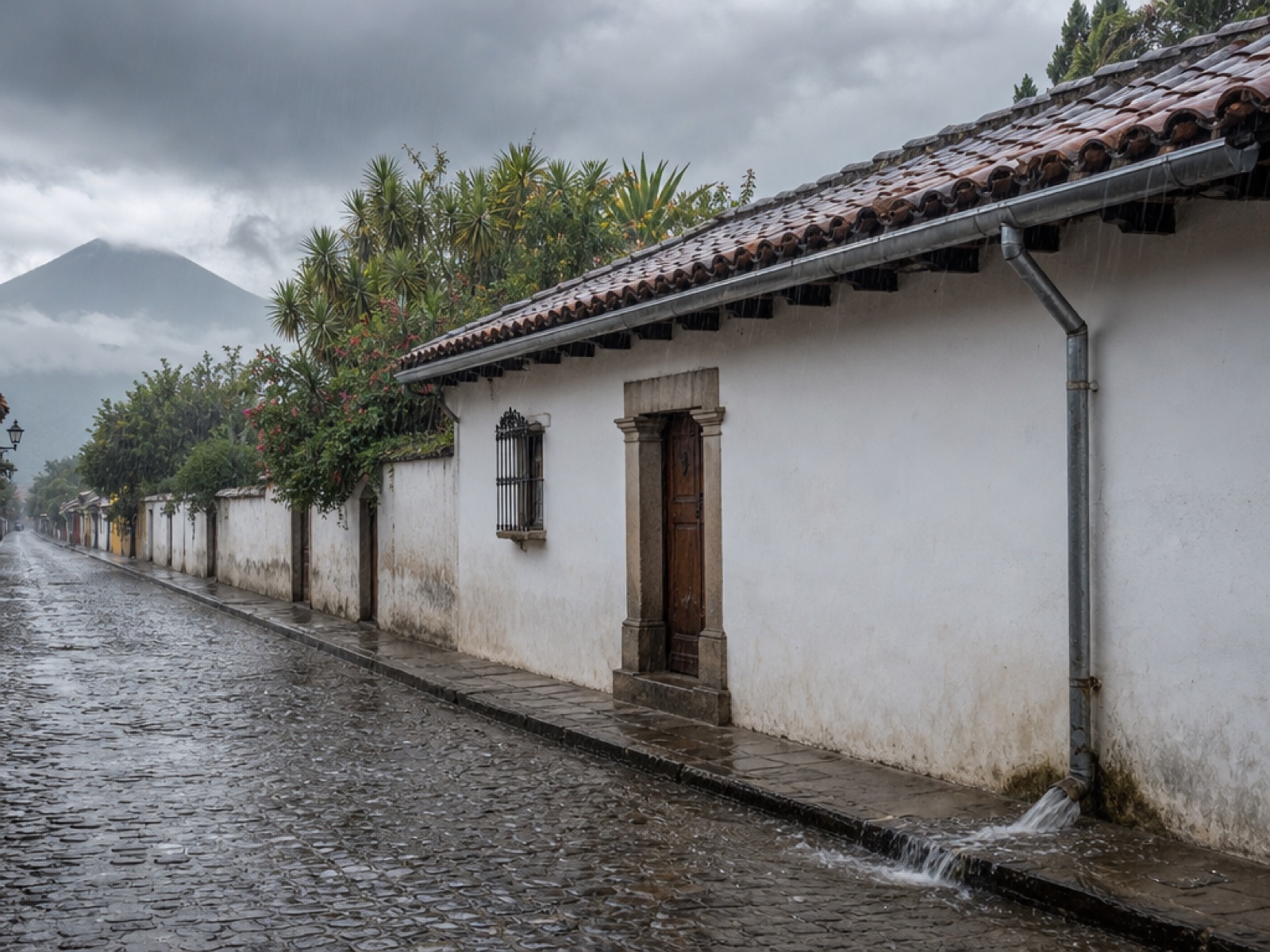
Antigua Guatemala sits on the flat floor of a valley at about 1,530 metres, and its rainy season runs from May to October. Rain does not arrive as months of grey drizzle: it arrives as a hard afternoon downpour, an hour or two long, roughly 150 times a year. So the question on any property is not whether water lands, but where it goes next. Most homes handle it well, the problems cluster in a few predictable places, and nearly all are visible in September.
How much rain does Antigua Guatemala get?
Dry season runs from November to April and the rains run from May to October. June, September and October carry the heaviest falls, while July and August usually relax into a short dry spell locals call the canícula. The shape of the season matters more than the total: five months of sun bake the ground hard, then intense volume arrives faster than it can soak away. The villages and slopes above town stay wet for days after the streets of Antigua have dried. For the month-by-month picture, see our rainy season guide.
Where does rainwater go on an Antigua property?
On a colonial home the path is short. Water lands on the clay teja, runs into a canaleta, drops through a metal bajada onto the patio or sidewalk, and the patio falls gently toward a drain that empties into the street. That last step is the original design: courtyards were built to shed water to the street, not to hold it.
The chain breaks in the same few places. A courtyard paved dead flat in a later renovation, with no fall to a drain. A downpipe that stops twenty centimetres above the ground, so water soaks the base of the wall instead of leaving. A drain rebuilt without enough slope, silting up inside one season. A lot where the street outside is higher than the patio behind the gate. Our roof maintenance guide covers the roof half of that chain.
Which lots and streets have drainage trouble?
Water finds the same addresses here:
- Low lots at the bottom of a slope, including the flat edges of Ciudad Vieja and the ground below Jocotenango, which collect what runs off above them.
- Lots cut into a bank, where the uphill neighbour’s garden drains toward your wall: the single most common problem on a slope.
- Courtyards sealed in concrete or tile with no drain, the most common owner-made fault and the usual source of salt bloom at the base of a wall.
- Streets where the municipal channel clogs. Leaves and rubbish block the street drains and one heavy storm pushes water back over the kerb. Local agents know these streets, and our neighborhood guide gives you the question to ask.
- Roofs that empty onto a wall, where a missing or short downpipe turns one wall into a permanent sponge.
How do you check drainage before you buy?
You cannot test drainage in the dry season, so do the work in the rain:
- Visit in September or October, or after any heavy storm, and check the base of every wall for a damp tide line, lifting paint or salt bloom.
- Compare the height of the street against the height of the patio, and check the gate threshold.
- See whether patio water reaches the drain or stands in a low corner.
- Follow each downpipe to where it ends.
- Look at the aljibe or tinaco overflow, and how the uphill ground is graded.
- Open the nearest municipal drain and look at what is sitting in it.
Ask the neighbours, not the seller, how the house behaved in the last big storm. The due diligence guide carries drainage on its checklist for a reason.
What does drainage work cost in Antigua Guatemala in 2026?
Installed prices, supply and labour, with material roughly half the total. Quetzal figures converted at about Q7.7 to the dollar.
| Work | Cost in Q | Cost in USD |
|---|---|---|
| Clear and rod a blocked drain line | Q400 to Q1,500 | $50 to $195 |
| Re-level a patio to fall to its drain, per m² | Q150 to Q400 | $20 to $50 |
| Replace a gutter run (canaleta), per linear metre | Q250 to Q600 | $30 to $80 |
| New downpipe (bajada), per linear metre | Q180 to Q450 | $25 to $60 |
| Area drain or rejilla, installed | Q600 to Q2,000 | $80 to $260 |
| French drain, per linear metre | Q600 to Q1,800 | $80 to $235 |
| Sump or pozo de absorción | Q4,000 to Q15,000 | $520 to $1,950 |
| Raised curb (regatón) across a gate entrance, per linear metre | Q350 to Q800 | $45 to $105 |
| Connect a property to the municipal drenaje | Q3,000 to Q12,000 | $390 to $1,560 |
| Divert one roof section into a rain tank, first flush and screen included | Q1,200 to Q3,500 | $155 to $455 |
Two bands are reused on purpose: the municipal connection matches our septic and sewage guide, and the roof-to-tank diversion matches the water storage guide. Holding a slope is a different job, priced in the hillside guide.
Which cheap fixes prevent most water damage?
Most drainage failures here are maintenance, not construction:
- Clear gutters, downpipes and patio drains before the first storm in May, then again in September.
- End every downpipe in a drain, a channel or a splash block, never against the wall.
- Never leave a courtyard paved flat. Water needs a fall of about one to two per cent to reach a drain.
- Keep the gate threshold a few centimetres above the street so runoff cannot enter from outside.
- Leave a gravel or planted strip of twenty to thirty centimetres between paving and the base of the wall.
Does drainage affect insurance and resale?
Home policies here cover water damage alongside fire, earthquake and landslide, so a repair is insurable rather than fatal. A documented history of flooding still travels with the property: a disclosure item, a negotiation point, and something the next buyer’s inspector will examine in exactly the places you did. The cheapest moment to fix drainage is before a listing, not after an offer. Our property insurance guide explains what is covered.
What about the damp that follows the water?
Water sitting against a wall is what feeds salitre, so most drainage work doubles as damp prevention, and a working courtyard drain also clears the standing water that breeds mosquitoes. If you capture roof water for the dry season, keep the tank inlet separate from the overflow. Our damp guide explains where the white bloom comes from and what stops it.
Buying around Antigua Guatemala?
If you are buying here, walk the property with someone who has seen it in the rain. We view homes all year and can tell you which streets drain and which need work before you sign. Start with our properties, services, or contact for a rainy-season viewing.
Interested in Antigua Real Estate?
Whether you're looking to buy, rent, or invest. I can help. Free consultation, no pressure.