
Finca and Country Property Near Antigua Guatemala
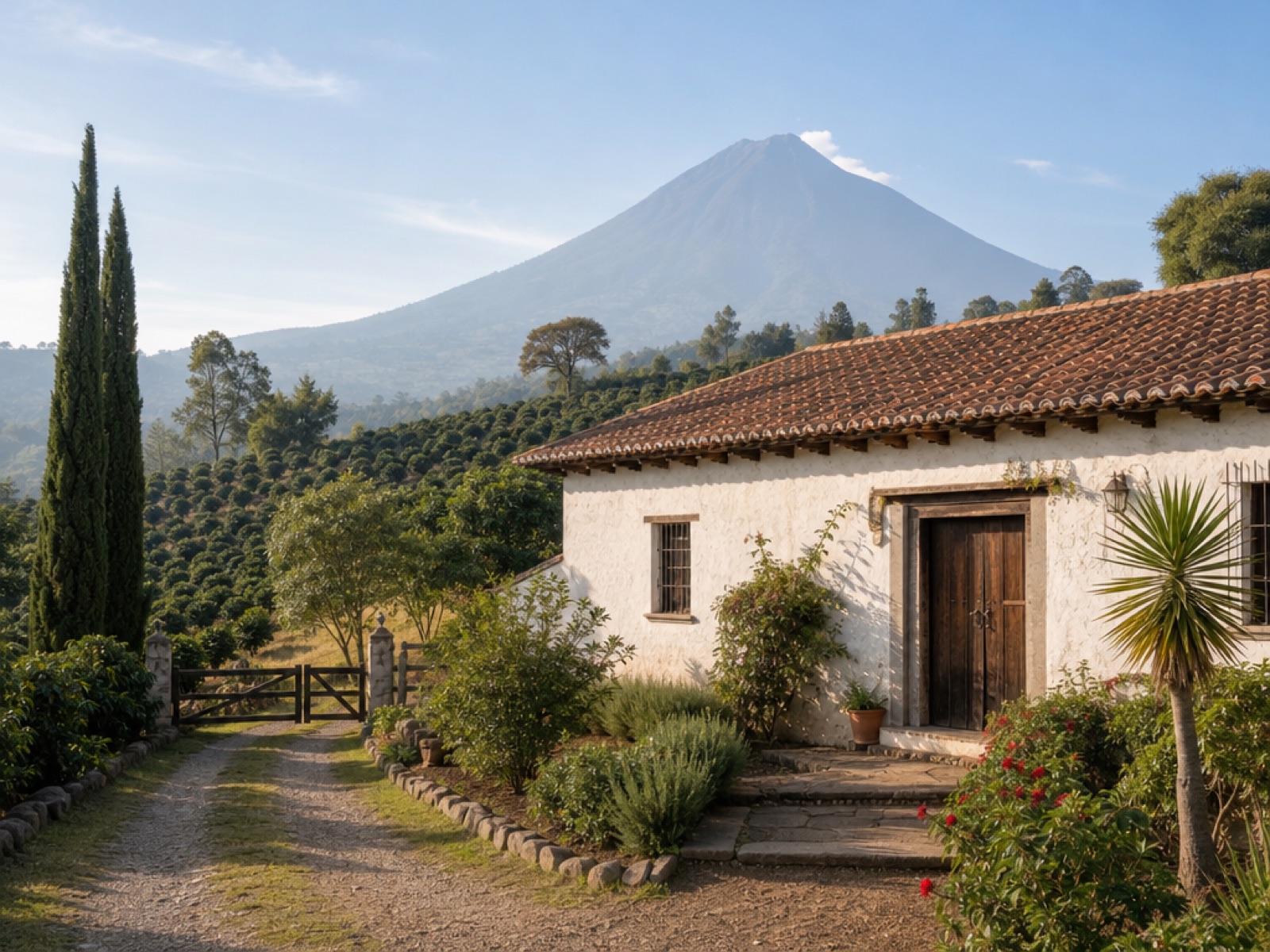
Antigua’s colonial centre gets the attention, but a steady share of foreign buyers end up living outside it, on a finca or a country property in the villages and hills that ring the city. Land and space cost less than inside the grid, and quiet and privacy come almost free, but you provide your own water, sometimes your own power, and a track that is smooth in February can be a test in October.
What counts as a finca near Antigua?
A finca simply means a rural property or smallholding, and around Antigua it covers a wide range: a working coffee, avocado or macadamia farm with a house and outbuildings; a country house on a few manzanas kept for weekends; a small parcel on the edge of a village such as San Juan del Obispo or San Pedro Las Huertas with room for a garden and animals; or raw land with an old colonial ruin to restore. A buildable lot on a village edge is a simple purchase; a working farm with workers, irrigation and a coffee harvest is a business as much as a home.
How much does a finca or country property cost near Antigua?
Access, water and slope set the price far more than size: a flat parcel on a paved road with a proven well costs multiples of a steep, dry parcel at the end of a long track. Rural land around El Hato and Pastores trades roughly between $15 and $50 per square metre, a small home or lot in an outlying village lands between $30,000 and $80,000, a house with usable land near San Miguel Dueñas or Ciudad Vieja runs $80,000 to $200,000, and a large finca with coffee and housing starts near $300,000 and climbs past $1,000,000. Inside the colonial grid land sells for $100 to $250 per square metre, so the same money buys several times the land just outside.
How do you get water on a finca?
Assume you will provide it. Municipal water reaches the city and the close-in villages, but on a finca the supply is usually a well, a nacimiento, or rainwater, held in a cistern or a tinaco. A complete well drilled to 40 or 60 metres and ready to use costs Q35,000 to Q120,000 ($4,500 to $15,500), and a 5 m3 underground cistern adds Q12,000 to Q30,000 ($1,550 to $3,900). Two things decide whether water is a bargain or a trap: the yield measured at the end of the dry season, and the legalisation file. Groundwater is regulated, the permit and legalisation run Q3,000 to Q12,000, and an unregistered well becomes a problem at resale. Our posts on water wells and water storage and rainwater cover the detail.
What about electricity and internet?
Grid power reaches most ring villages, but the last stretch is yours to pay for. Running a line and a pole to a property about 100 metres off the road typically costs Q8,000 to Q25,000 ($1,040 to $3,250), and beyond that off-grid solar is often cheaper. A 3 kW solar system with batteries, enough for lights, a fridge, wifi, fans and a television, lands between $4,000 and $5,700 installed, and a 5 kW system that also carries a water pump and a washing machine runs $6,500 to $9,500. Internet is the second question: cable reaches the villages, but a property further out depends on a mobile router or satellite, so test the signal on site at the hour you would use it, not on a coverage map. See solar energy and internet and wifi.
Is the road passable in the rainy season?
This question decides more finca purchases than any other. Between May and October an unpaved road that is fine in the dry season can rut, wash out at a culvert, or turn to a slick a two-wheel-drive car will not climb. Visit in the rainy season, not on a bright January weekend, and drive the whole route in the car you actually own. Confirm the access on paper too: the right to cross a neighbouring parcel is a servidumbre de paso, and if the only way in crosses someone else’s land, that right belongs in the deed, not in an informal agreement. On many fincas a four-wheel-drive is a practical necessity, and our guide to getting around Antigua explains local transport.
Can foreigners buy a finca in Guatemala?
Yes. Foreigners own rural and urban property in Guatemala on the same terms as citizens, with title in their own name at the Registro de la Propiedad, and no residency is needed to buy. The constitutional limits on foreign ownership apply near the borders, on the coast and on islands, none of which touch the highlands around Antigua. What catches buyers out is measurement and title rather than nationality: rural land is measured in manzanas and varas, boundaries in older deeds are often approximate, and the registry is not fully digitised, so an independent title search and a survey matter even more here than inside the city. Our guides to buying land and land measurements explain both.
What does a finca cost to run?
A finca is usually cheaper to buy and dearer to keep than a house in town. Typical 2026 supply-and-install figures for the Antigua area:
| Item | Typical 2026 cost |
|---|---|
| Complete well, 40 to 60 m, ready to use | Q35,000 to Q120,000 ($4,500 to $15,500) |
| Underground cistern, 5 m3 | Q12,000 to Q30,000 ($1,550 to $3,900) |
| Off-grid solar system, 3 to 5 kW with batteries | $4,000 to $9,500 |
| Extend grid power about 100 m with a pole | Q8,000 to Q25,000 ($1,040 to $3,250) |
| Perimeter fence or block wall, per linear metre | Q450 to Q900 ($60 to $115) |
| Gardener or caretaker, weekly visit | Q200 to Q400 ($26 to $52) |
| Full-time casero (caretaker), monthly | From about Q3,800 ($500) |
You also carry the same annual costs as any Antigua home, roughly 1% of value a year in maintenance, plus a longer perimeter to keep and a caretaker if you are often away. Our posts on the cost of owning a home and hiring domestic help cover both.
Who is finca living right for?
It suits owners who value space, privacy and quiet, who want animals, a productive garden or a few acres of coffee, and who are content to drive for dinner and a supermarket. It suits second-home owners less well unless they keep a caretaker, because an empty house at the end of a track needs someone to walk it every week. And it serves poorly the buyer who needs walkable streets, fast internet or a short walk to a clinic, real needs worth admitting.
How do we help?
Tell us how you want to live rather than which village you have heard of. We match buyers with fincas and country properties whose access, water and title hold up, arrange the survey, well test and title search through local attorneys, and coordinate the work that turns a parcel into a home. Start with what is for sale now, or write to us and describe the life you want.
Interested in Antigua Real Estate?
Whether you're looking to buy, rent, or invest. I can help. Free consultation, no pressure.